Reference
The glossary
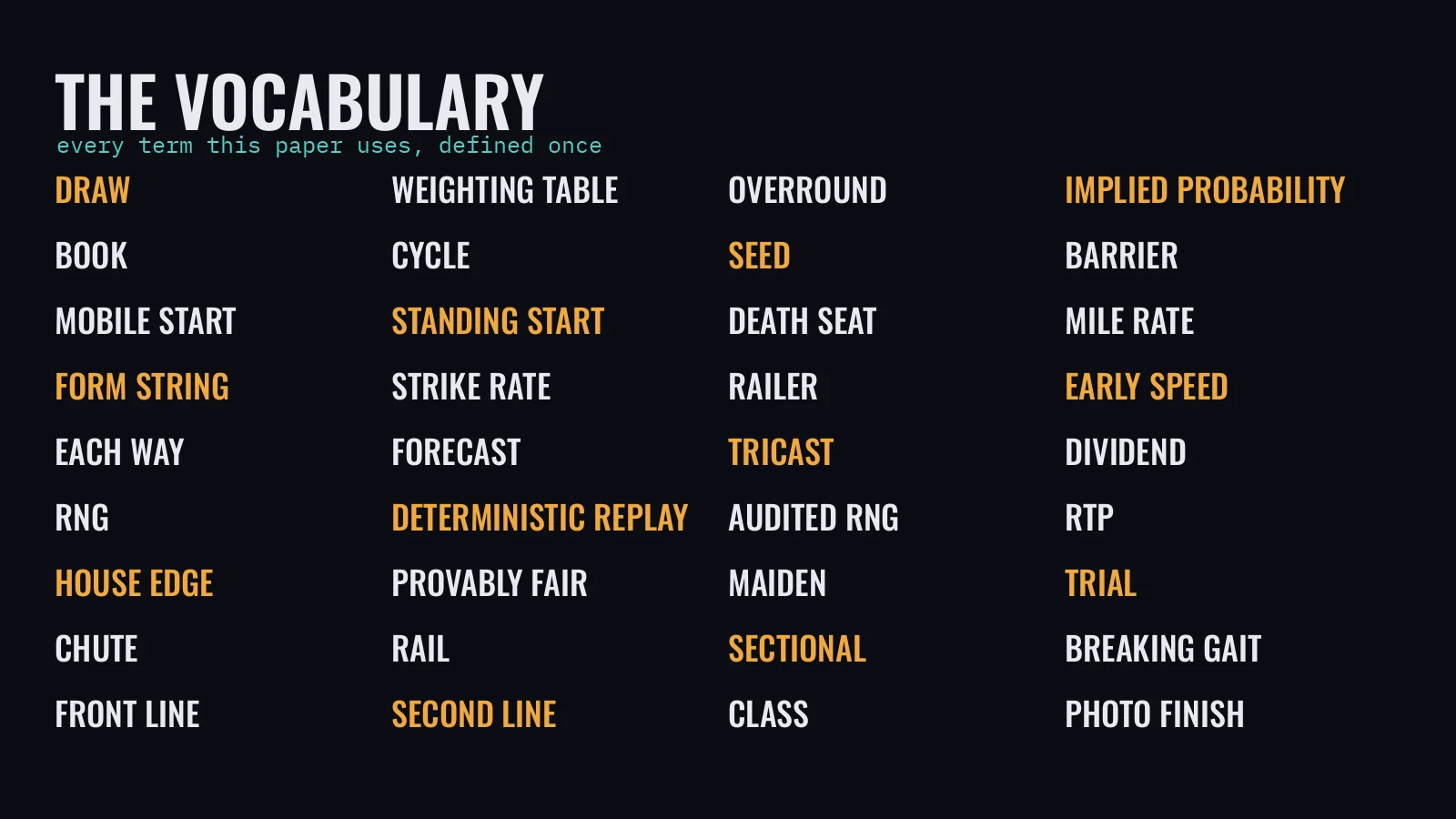
89 terms, anchored and linked from every section of the paper: 36 on the product, 34 on racing and 19 technical.
- 89Terms
- 36The product
- 34Racing
- 19Technical
Words in daily use and written down nowhere
as at 25 October 2026 · engine GP-Draw 4.2
Every word on this page is in daily use somewhere in virtual racing. A Gallop Post survey of the sites that rank for virtual racing results, carried out on 18 October 2026, found no glossary on any of them — no definition of forecast, tricast, starting price, each-way terms, the draw or the overround, on sites whose entire output consists of those words.
The entries fall into three kinds, which matter more than the three group headings. Some are borrowed: harness racing has the best working vocabulary in the sport and the cards use it, so the death seat and the one-one are defined as the real codes define them, then marked as descriptions of what the screen showed rather than explanations of a result. Five exist to say that a term does not apply here — going, track rating, starting price, dead heat, and Group and Listed status — because a missing column is better explained than left to puzzle over.
A handful had to be written. Numbers held, weighting table, draw id, published seed and settle are the columns this paper exists to print, and not one of them had a published definition to borrow. Where the sources disagree, the entry records the disagreement and the date it was read rather than resolving it. How a virtual race is decided sets out the method these words describe, and the column that went with this page explains how the list was built.
Every term, A to Z
89 anchors · 20 letters
No term matches that combination. Clear the filter to see all 89 again, or jump from the A-to-Z index.
The product
36 terms
The draw, the book, the card, and every figure printed beside them.
- Betting window
-
The part of a cycle in which a commercial virtual race accepts bets, closed by an on-screen countdown.
A commercial cycle is split between a betting window and the race. GLI-33 v1.1 (revision date 14 May 2019) requires a scheduled virtual event to show a countdown, to stop accepting wagers once it expires, and to make it impossible to work out the result before the event begins.
Gallop Post takes no bets, so the circuit has no betting window. What the cycle strip counts down to is the next card and its settle time.
See also: Cycle, Settle, Reconstruction
- Book
-
The sum of the implied probabilities of every price in a field, as a percentage.
Add 100 divided by each decimal price across the field. A book of exactly 100 would return every credit staked; a commercial book sits above it. The eight prices in the Kurrajong Mile imply 16.5, 22.8, 5.0, 18.6, 6.5, 5.5, 31.1 and 8.6 per cent, which is a book of 114.6 — the 14.6 points above 100 sitting where a commercial margin would.
Every Gallop Post card prints its book total beside the weighting table. The numbers held always sum to 1,000 and so to 100.0 per cent, because they are shares of one draw; the book is read off the prices, not off the weights.
See also: Overround, House margin, Implied probability, Weighting table
- Compensated game
-
A game or virtual event that shifts the chance of a win according to what it has already paid out.
The Gambling Commission defines compensated games as "Games or virtual events that adjust the likelihood of winning outcomes occurring based on previous payouts or intake", and RTS 7A does not permit them in Britain (Remote Gambling and Software Technical Standards, read 18 October 2026). GLI-33 v1.1 §4.5 states the same rule from the other side: outcomes selected by the generator may not be modified or discarded because of adaptive behaviour.
This is the rule that makes a published weighting table worth printing. If a draw could be re-weighted according to last night's results, the table on the card would describe nothing.
See also: Adaptive behaviour, RTS 7, Weighting table
- Cycle
-
The fixed interval from one race to the next on a virtual circuit.
Sportradar's Betradar Virtual Horses page states a two-minute cycle (read 18 October 2026). Sky Bet's virtual racing rules say racing runs 24 hours a day with each race lasting 30 to 45 seconds. ATG's own launch release of 12 October 2015 put its Virtuell Racing product on a new race every six minutes. The gap between races is a betting window and a result, not race time.
Gallop Post publishes a cadence per venue — a day rate and an overnight rate — on racecourses/, and the cycle strip on circuit pages shows the next three races.
See also: Betting window, Feed, Settle
- Dead heat
-
A tie for a placing; a weighted draw without replacement cannot produce one.
A number is drawn once, and the runner holding it leaves the pool. Two runners therefore cannot share a placing and no runner can fill two. Gallop Post results carry exactly one runner per position, and the validator rejects anything else.
The impossibility is not universal across the industry. GLI-33 v1.1 §A.6 still requires an operator's house rules to cover dead heats, because a product whose result is computed by a physics engine can tie.
See also: Without replacement, Draw, Physics engine
- Dividend
-
A payout per unit staked, declared from the result rather than taken as a price.
A dividend is worked out after the event from the pool and the finish, which is why it is quoted per unit instead of as odds. Betfair's virtual rules work this way for forecast bets: no price is offered when the bet is struck, and the return is a dividend determined by the result (operator rules page read via a search extract, 18 October 2026).
Resulted Gallop Post cards print Win, Place, Forecast and Tricast dividends as reference figures. Nothing is staked here, so no dividend is ever paid.
- Draw
-
The weighted selection of numbers that decides a simulated race.
The industry describes a virtual race as a visual representation of a computerised number draw: shorter-priced runners hold more numbers, and each number can be drawn only once. bet365's virtual sports rules call the product "a computer generated presentation of a totally random number draw result where the outcomes are decided by numbers selected by a Random Number Generator (RNG)" (read via a search extract, 18 October 2026), and Sky Bet's rules put it the same way.
On this circuit the draw is run by GP-Draw 4.2 and the whole of it is published: numbers held per runner, the implied percentages, the book, the seed and the settle time. The sequence is set out step by step on how-it-works.php.
See also: Weighting table, Numbers held, Without replacement, RNG
- Draw id
-
The reference identifying one Gallop Post draw: venue code, date, race number.
A draw id reads KUR-2026-10-18-R4 — venue, date, and the race's position on that venue's programme. It is printed in the card header and carried in the machine-readable results file, so a race, its weighting table and its seed can be quoted without ambiguity.
See also: Published seed, Reconstruction, Replay
- Each-way
-
One stake split between a win bet and a place bet, the place half paid at a fraction of the win odds.
Two credits each way on a 6.00 runner is one credit to win and one to place. A decimal 6.00 is 5/1, so in a field of 12 or more, where this circuit's place half pays 1/4 odds, that half pays 5/4 — decimal 2.25. First place returns 6.00 on the win half and 2.25 on the place half, 8.25 in all; a placing returns 2.25 and the win half is lost.
The fraction and the number of places move with field size. Sky Bet publishes virtual each-way terms in runner bands of 8–11, 12–15 and 16 (rules page read 18 October 2026). The bands used on this circuit are set out under place terms and printed on every card.
See also: Place terms, Field size, Fixed odds
- Feed
-
The data stream carrying fields, prices and results from a virtual-sports supplier to an operator.
In the retail trade the brand and the content are usually different companies. SIS announced on 30 November 2023 that it would distribute upgraded Inspired-built virtual horse and greyhound products under the 49's brands Portman Park, Sprint Valley, Steepledowns, Brushwood and Millersfield. GLI-33 v1.1 §A.6 requires an operator settling from an external results feed to hold procedures for the feed being unavailable and for results that change after the event.
Gallop Post takes no feed in and sells none out. The circuit is generated here and published here, and the downloadable results file is built from the same rows the pages render.
- Field size
-
The number of runners in a race, fixed when the card is published.
Commercial products settle on a handful of standard sizes. Sky Bet publishes each-way bands for 8–11, 12–15 and 16 runners, and William Hill's virtual return-to-player table is laid out against 8, 10 and 16 (both read 18 October 2026), which puts 16 at the practical maximum on those products.
Every Gallop Post venue publishes a minimum and maximum field on racecourses/. A field does not change once the card is up: the runners are generated with the race, so there is nothing to withdraw and no scratching to allow for.
See also: Place terms, Each-way, Starting price
- Fixed odds
-
A price paid as shown when the bet was struck, which is the only way a virtual price works.
Sky Bet's virtual racing rules state that "All bets will be settled at the fractional odds stated" (read 18 October 2026), and Betfair's virtual rules settle in-race bets only at the odds offered when the bet was placed. There is no later price to fall back on, because no on-course market exists behind the animation.
Gallop Post prices are indicative reference numbers, published next to the weighting they were derived from. They are not available anywhere and nothing can be staked on them.
See also: Starting price, Implied probability, Book
- Forecast
-
Picking the first two home in the correct order.
GLI-33 v1.1's glossary calls the same bet a perfecta or exacta. Betradar's Virtual Horses page offers full forecast, tricast and combination bets, and notes that the offer is not limited to the most likely outcome (read 18 October 2026).
A forecast figure is computable from the weighting table, because a draw without replacement gives a defined probability to any exact order: the first runner's share of the draw, multiplied by the second runner's share of what is left once the first has gone.
See also: Tricast, Quinella, Renormalisation
- House margin
-
The amount by which a commercial book exceeds 100 per cent, and so the share of turnover it holds.
A book of 114.6 returns 100 ÷ 114.6, or 87.3 per cent of turnover over a long run, and holds 12.7. William Hill publishes 82.64 to 90.91 per cent on its virtual win and each-way racing markets, which is a book of roughly 110 to 121 (help page read via a search extract, 18 October 2026). The margin is structural and disclosed; it is not evidence of a crooked draw.
Gallop Post holds no margin, because it takes nothing. The book is printed because it is the measurable distance between the prices and the weights.
See also: Book, Overround, House edge, Return to player (RTP)
- Implied probability
-
A price restated as a percentage: 100 divided by the decimal price.
Prices and probabilities are two notations for one quantity: a decimal 4.00 implies 25 per cent, and 2.74 implies 36.5. Running it the other way round, Red Gum Rebel held 309 numbers of the 1,000 in the Class C Mobile Pace at Kurrajong Paceway — 30.9 per cent of the draw — and the price that returns exactly that chance is 1,000 ÷ 309 = 3.24. The card showed 2.74.
Every Gallop Post runner row prints both halves: the numbers the runner holds in the draw with the true percentage that follows from them, and the percentage its price implies. The first sums to 100.0 per cent, the second to the book, and the gap between the two is the whole of what a margin is.
See also: Numbers held, Book, Weighting table
- Numbers held
-
The block of numbers a runner holds in the draw: its chance written as a count.
Gallop Post weights a field out of 1,000 numbers. In the Kurrajong Mile, Night Shift holds 271 of them and wins 27.1 per cent of draws, while Salt Pan holds 44 and wins 4.4 per cent. The eight blocks sum to 1,000 with nothing left over, so some runner always wins.
This is the raffle version of what a price says. The shorter the price, the bigger the block — and because the block is published, the two can be held up against each other.
See also: Weighting table, Implied probability, Draw
- Overround
-
The points by which a book exceeds 100 per cent.
The Kurrajong Mile's 114.6 book carries a 14.6-point overround. The rule of thumb repeated in trade and reference accounts of the format — about 2 per cent per runner, sometimes less in a big field — is thinly sourced, but it lands an eight- or ten-runner book in the 110s to the low 120s, which squares with the return-to-player figures operators publish.
In a commercial product the overround is where the margin lives. Here it is a published number with no money behind it.
See also: Book, House margin, Return to player (RTP)
- Photo finish
-
A close-finish camera view; in a draw-based product it renders a margin rather than deciding one.
Betradar lists a photo finish among the features of its Virtual Horses product (page read 18 October 2026). It is a presentation device. The finishing order already exists, because the draw settled it before the first frame was rendered, and the camera is drawing a margin the engine assigned.
- Place terms
-
How many placings the place half of an each-way bet covers, and at what fraction of the win odds.
Gallop Post prints its terms on every card, by field size: four to seven runners, 1/5 odds, places 1-2; eight to 11 runners, 1/5 odds, places 1-2-3; 12 or more runners, 1/4 odds, places 1-2-3-4. Fields on this circuit run from four at Brolga Park to 14 at Saltbush Flat, so those three bands cover it.
Commercial products use the same band structure with their own numbers — Sky Bet publishes bands of 8–11, 12–15 and 16 runners (rules page read 18 October 2026). Terms are a house choice, not a law of the format.
See also: Each-way, Field size, Dividend
- Pre-recorded racing
-
A product that draws a result and then plays the matching footage of a real race already run.
Not every simulated race is animated. Golden Race, founded in 2006, lists two horse games built on pre-recorded historical footage, Horses6 and Horses8, alongside a real-time engine, Horses 3D, with six to 12 competitors (company product pages read 18 October 2026). NSoft describes its Greyhound Races title as the only game in its virtual portfolio that uses real-life footage with generator software behind it (product page read 18 October 2026).
The mechanism is unchanged: the numbers decide and the pictures follow. Only the pictures are archival.
See also: Real-event simulation, Draw, Physics engine
- Published seed
-
The seed Gallop Post prints on every card so that a past race can be recomputed.
Each race carries a 16-character seed and the full weight vector it was drawn against. The two together make the result reproducible: feed them back into GP-Draw and the same finishing order comes out. No commercial virtual product publishes this.
The regulated analogue is a record-keeping duty rather than a publication duty. GLI-33 v1.1 §A.6 requires an operator to keep enough information to reconstruct its virtual events for 90 days, but not to show anyone the numbers.
See also: Seed, Reconstruction, Deterministic replay, Draw id
- Quinella
-
The first two home in either order.
GLI-33 v1.1's glossary defines it as a wager in which the first two places are predicted "but not necessarily in the finishing order". It is standard on Australian pools, and Tabcorp's Trackside offers fixed returns on it alongside Win, Place, Trifecta and First 4.
Like a forecast, it falls out of the weighting table: add the probabilities of the two orders.
- Real-event simulation
-
A one-off computed running of a real field, which makes a claim a scheduled virtual race never makes.
The Australian example is the Lexus Melbourne Cup "The Race of Dreams", built by Inspired Entertainment for the Victoria Racing Club and broadcast on Network 10 ahead of the real Cup on 3 November 2020: 24 past Cup champions, with Makybe Diva the official winner from Phar Lap (Inspired release dated New York, 10 November 2020). The Virtual Grand National, devised with Inspired and Aintree, ran in 2017, 2018 and 2020 according to the Jockey Club's own page, and the 2020 running drew close to five million British viewers in place of the cancelled race.
A simulation of a real field can be scored against reality, and the accuracy claims on record come from its producer. A scheduled virtual race cannot be scored at all, because there is no fact outside the draw for it to be right about.
See also: Pre-recorded racing, Virtual event, Draw
- Reconstruction
-
Keeping enough of a virtual event on file to rebuild it afterwards.
GLI-33 v1.1 §A.6 requires an operator to "maintain all information necessary to adequately reconstruct the virtual events, including the virtual event outcome and/or virtual participant actions, conducted within the past 90 days", by some combination of text, logs, video, graphics or screen captures.
Gallop Post meets the idea by publishing rather than archiving. The seed and the weights sit on the race page, and the same rows go into the downloadable results file.
See also: Published seed, Deterministic replay, GLI-33
- Renormalisation
-
Recalculating the surviving runners' shares after each placing is drawn.
Once first place is drawn the winner leaves the pool and the remaining numbers no longer sum to 1,000, so second place is drawn from the survivors in proportion to what they still hold. The virtual-racing patents describe exactly this: a value is drawn from a range divided among the runners, and the remaining portions are readjusted after each horse is drawn (US 6,921,331 and US 7,291,070).
Worked through on the Kurrajong Mile: if Night Shift wins on its 271 numbers, 729 are left, and Black Stump goes from 19.9 per cent of the win draw to 27.3 per cent of the draw for second.
See also: Without replacement, Draw, Forecast
- Replay
-
Watching a race again, as distinct from recomputing it.
A replay on a commercial product is a stored rendering. On this circuit the race page carries the draw the rendering came from, so both are available: watch the frames again, and check the finishing order against the weights and the seed that produced it.
See also: Deterministic replay, Published seed, Photo finish
- RNG
-
The random number generator that picks the numbers deciding a simulated result.
GLI-33 v1.1 defines a random number generator as "A computational or physical device, algorithm, or system designed to produce numbers in a manner indistinguishable from random selection", and its §4.5 requires virtual event outcomes to come from a cryptographic one. William Hill tells customers its virtual results are "determined by an accredited RNG (Random Number Generator)" (help page read via a search extract, 18 October 2026).
A generator decides nothing on its own. What turns a number into a result is the weighting table it is drawn against, which is the half of the mechanism nobody else prints.
See also: Cryptographic RNG, PRNG, Weighting table
- Settle
-
The moment a result becomes official and the card is closed.
In the trade, settling is paying and losing: virtual bets settle to the supplier's published result, and bet365 states that results provided by the official virtual sports provider are used to settle all virtual wagers (read via a search extract, 18 October 2026).
Nothing is paid here, so settling means only that the draw is final and published. Every Gallop Post race prints a settle time beside its start time, usually a minute apart.
- Starting price
-
The on-course price a real bet can be settled at; simulated racing has none.
Real-racing rulebooks fall back on a late or last-shown price where no official starting price exists — Betfred settles to "the last price we show" (read via a search extract, 18 October 2026). A simulated race has no on-course market behind it and no late money to move a price, so every price is the fixed one that was displayed.
Gallop Post cards carry no starting-price column and the data holds no key for one.
See also: Fixed odds, Implied probability, Field size
- Trackside
-
The animated racing game run in Australian TAB outlets, and the reason simulated racing is lawful here.
The Totalizator Amendment Act 2010 (NSW) amended the Totalizator Act 1997 so that "a betting activity on computer simulated horse, harness or greyhound racing" could be approved, and its explanatory note names the game as Trackside. Section 15AA of the 1997 Act reserves the exclusive approval for computer simulated racing events to TAB Limited, tied to its licence term running to 2097. A Tabcorp submission to the House of Representatives inquiry into online gambling describes Trackside as "an animated racing game that is authorised under wagering licences issued to Tabcorp in NSW, Victoria and ACT" (submission read 18 October 2026).
Western Australia is the outlier: a state government statement of 1 June 2004, headed "No Trackside for TAB", said the product was considered a casino game in every state except Victoria and Tasmania. The markets are thoroughbred, harness and greyhound, with fixed returns on Win, Place, Quinella, Trifecta and First 4.
See also: Virtual event, Quinella, Feed
- Tricast
-
Picking the first three home in the correct order.
GLI-33 v1.1 defines the equivalent trifecta as "a wager in which a player wins by selecting the first three finishers of a competition in the correct order of finish". Resulted Gallop Post cards print a reference tricast figure beside the win and place dividends.
With a draw of 1,000 numbers the arithmetic runs in three steps: the winner's share, then the second runner's share of what is left, then the third runner's share of what is left after that.
See also: Forecast, Quinella, Renormalisation
- Virtual event
-
A simulated event offered for betting as though it were a real one.
British regulation defines the term by reference to section 353(3) of the Gambling Act 2005 and treats betting on virtual events as its own licensed activity: a remote general betting (standard) (virtual events) licence is a named category, carrying an annual games-testing audit (Gambling Commission testing strategy and RTS definitions, read 18 October 2026). GLI-33 v1.1 defines virtual event wagering as betting "on sports, contests, and matches whose results are determined solely by an approved Random Number Generator".
The licensing detail shapes the reporting on this site. The questions worth asking of a virtual product are generator questions, not form questions.
See also: Virtual participant, RTS 7, GLI-33
- Virtual participant
-
GLI-33's term for a runner in a simulated race.
GLI-33 v1.1 defines it as "The athlete or other entity that competes in a virtual event", requires each participant to be unique in appearance where appearance is relevant to the bet, and requires that statistical data shown to the player must not misrepresent any participant's capabilities.
Gallop Post calls them runners, gives them liveries on colours/ and records them on horses/. A runner here is a name attached to a block of numbers, and the site says so rather than implying anything else.
See also: Virtual event, Numbers held, Weighting table
- Void
-
A race cancelled with stakes returned, usually after a malfunction or a result that cannot be determined.
Sky Bet's virtual rules void a race and refund stakes where it does not start, where the outcome is incomplete, or where a result cannot be determined for any reason, and carry the standard clause that a malfunction voids all pays and plays (read 18 October 2026). Unresolved bets on incomplete races are returned after 90 days.
Nothing is staked on this circuit, so nothing can be refunded. A draw that fails to produce a complete finishing order is not published as a race at all.
See also: Settle, Dead heat, Reconstruction
- Weighting table
-
The published list of how many numbers each runner holds, and the percentage that follows.
The table is the race. It gives every runner's numbers held of the 1,000, the implied percentage, the price that percentage corresponds to, and the book the printed prices add up to. Commercial products hold the equivalent internally and publish none of it, which is the one thing this paper does differently.
Read with the seed, the table makes a result checkable instead of merely watchable. There is a worked card on how-it-works.php.
See also: Numbers held, Implied probability, Book, Published seed
- Without replacement
-
A number is drawn once, so a runner leaves the pool as soon as its number comes out.
This is the structural rule behind most of what the data model forbids: one runner per placing, no runner in two placings, no dead heat, and a defined probability for any exact finishing order. The industry's own description says the same — each number can be drawn only once, and therefore the same selection cannot come first and second — and the operators' own rules pages repeat it (read 18 October 2026).
Statistically it is sequential sampling from a weighted set, which is why forecast and tricast figures can be computed from the win weights rather than priced separately.
See also: Renormalisation, Dead heat, Forecast
Racing
34 terms
Words borrowed from the real codes — including the five this circuit refuses.
- Barrier
-
The numbered starting position a horse begins from.
Barrier is the Australian word for the starting stall in thoroughbred racing, and for a horse's position in the line behind the mobile barrier in harness racing. Greyhounds use box, never trap, which is British usage; the demo at play/ was relabelled accordingly, and its TRAP strings now read BARRIER.
On this circuit barriers are unique within a field and the draw does not weight them. A barrier is a number on a card. What decides the race is the block of numbers printed beside it.
See also: Box, Draw, Numbers held
- Box
-
The greyhound starting stall, numbered 1 to 8 from the inside.
Australian official usage is box throughout. Greyhound Racing Victoria's glossary defines starting boxes as the boxes where greyhounds commence the start of a race (read 18 October 2026), and its grading guidelines of December 2025 define a field as a maximum of eight greyhounds plus up to two reserves. Rug colours run with the box under Greyhounds Australasia Rule 85, effective 1 May 2022: 1 red, 2 black and white stripes, 3 white, 4 blue, 5 yellow, 6 green, 7 black, 8 pink.
Brolga Park runs boxes 1 to 8 over 400, 520 and 600 metres, and its cards print box in place of barrier.
- Box draw
-
The allocation of starting boxes to a greyhound field.
Greyhound Racing Victoria defines the box draw as the official random computerised allocation of starting positions (glossary read 18 October 2026). Its local rule 54A also provides for a preferential box draw: a partially random allocation that factors in a greyhound's preferred early race trait and uses it to set the boxes (Grading Guidelines, December 2025).
The preferential draw is the official basis for the idea that a dog has a running style, and the closest thing in real racing to a published weighting.
See also: Box, Railing, Early speed
- Breaking gait
-
A pacer or trotter abandoning its gait for a gallop.
Australian rule 155A requires a horse that breaks clear of interference and is still in the wrong gait at the finish to be placed behind any horse covering its body, provided that horse is in its correct gait (Harness Racing Victoria notice on the national rule, read 18 October 2026). Under the Western Australian rules of 1999 a driver must take immediate action to restrain a horse to its correct gait, and stewards may place or disqualify it where the break gained ground or caused interference.
Gallop Post uses the term only when writing about real harness racing. The circuit has no incident model: placings come out of the draw, and no result here turns on a break.
See also: Pacer, Mobile start, Score-up
- Career record
-
A runner's starts, wins, seconds and thirds, in that order.
Harness Racing Australia's form-guide key prints it as Starts-Wins-Seconds-Thirds (read 18 October 2026), so 42-9-7-6 is 42 starts for nine wins, seven seconds and six thirds, a 21.4 per cent strike rate. The real key adds lifetime stakemoney. Nothing is staked on this circuit, so that column prints an em dash and a footnote.
A record on horses/ only ever grows, card by card from oldest to newest, and the runner's form string ends with its most recent finishing position.
See also: Form string, Strike rate, Class
- Chute
-
A spur off the main circuit that lets a race start on a straight line.
A chute adds a straight approach so a trip can begin without a bend. Saltbush Flat is the extreme case on this circuit: a 1,200 metre straight course and nothing else, with the chute doing the whole job.
Where a venue has one, its length and the distances it serves are published on racecourses/ beside the generated track map.
- Class
-
The grade of a race; on this circuit Feature, Class A, Class B, Class C, Maiden or Trial.
Group and Listed status in Australian racing is conferred by a principal racing authority, and the governance of that pattern is not settled: the Asian Racing Federation has said the Asian Pattern Committee took temporary responsibility for all Australian black-type races from December 2025 while Racing Australia restores a compliant system (ANZ Bloodstock News, read 18 October 2026). This circuit has no principal racing authority and no pattern committee, so it has no Group races, and how-it-works.php says so plainly. Its six classes are a programming ladder and nothing more.
The real codes have left classes behind in different directions. Harness racing replaced its multi-tiered class system with the national Rating Based Handicapping System on 1 July 2019, while greyhound racing grades on wins: Greyhound Racing Victoria takes a maiden winner to Grade 7, then Grade 6 at two wins and Grade 5 at three (Grading Guidelines, December 2025).
See also: National Rating, Maiden, Trial, Handicap
- Death seat
-
The spot directly outside the leader, with no cover and all of the breeze.
Harness Racing New Zealand's glossary describes it as the position outside the leader, and usually the toughest run in a race (read 18 October 2026). One off the rail, nothing in front to shelter behind, and ground given away on every turn.
It is the most useful borrowed phrase on a simulated card and the easiest to misuse. A Gallop Post race report may say where the screen showed a runner; the placing still came out of the draw.
See also: One-one, Parked out, Rail
- Early speed
-
A runner whose best work is in the opening sections; read off split times, not off a rating.
Greyhound Racing Victoria's glossary, read 18 October 2026, has no entry for early speed. The official measure is split times: the time in seconds in which the leading greyhound reached a designated section of the track. The phrase itself is form-reader's shorthand.
On this circuit it is shorthand with nothing behind it. A runner with a reputation for early speed holds exactly the numbers the weighting table gives it.
- Form string
-
The run of recent finishing positions printed under a runner's name.
Gallop Post writes form oldest first and most recent last, hyphen-separated. So 3-1-4-2-1 is five starts: a third, then a win, then a fourth, then a second, then a win last time out. A 0 is a finish of tenth or worse.
There are no letters in a string here. Harness Racing Australia's form-guide key, read 18 October 2026, uses s for a spell and a hyphen for the end of a season, but this circuit runs one published programme with no spells and no seasons, so there is nothing for a letter to mark. Direction is the thing real form products disagree about, between codes and between countries; the convention above is printed on the cards and on how-it-works.php so that a string never has to be guessed at.
See also: Career record, Strike rate, Class
- Front line
-
The first row of a harness field at the start, drawn across the track from the inside out.
Harness Racing Australia's starting rules, current to 17 July 2026, require that as far as practicable horses are drawn up before the start according to their handicaps, that horses on the same mark are drawn in their barrier positions, and that the Chief Steward determines how many horses start in any line. Capacity is a track attribute: HRA's own track pages give Menangle a front line of 10 for both mobile and standing starts, and Melton 7.
Gallop Post harness cards print the barrier number and the start type. The geometry of Kurrajong Paceway and Gidgee Paceway is published on racecourses/.
See also: Second line, Mobile start, Standing start
- Going
-
The British word for the state of the surface; it means nothing on a simulated track.
Going runs from firm through good and soft to heavy, and describes how much give there is in real turf on the day. Australia publishes the same judgement as a numbered track rating.
A simulated surface takes no rain and does not chop out. The surface on a Gallop Post card is a fixed parameter of the venue, identical in the first race of the cycle and the last, so the cards print the surface and stop there. A going description here would be a word with no measurement behind it.
See also: Track rating, Rail, Straight
- Handicap
-
A race that equalises chances by weight in gallops, or by starting mark in harness.
In thoroughbred racing the handicapper allots weight. In harness standing starts the equivalent is distance behind the front line, and Harness Racing Australia's starting rules, current to 17 July 2026, draw such a field up according to those handicaps.
On this circuit the equalising is done in the open, by the weighting table. A Gallop Post handicap is a race whose numbers are spread more evenly than a Feature's, and the table on the card shows exactly how evenly.
See also: Class, Standing start, Weighting table
- Length
-
The margin unit in gallops: roughly one horse's body length.
Thoroughbred margins are reported in lengths, and margins under a length as a neck, a head or a nose. Australian harness racing does it differently and reports margins in metres, as Harness Racing Australia's form-guide key shows (read 18 October 2026).
Gallop Post follows each code's own habit: lengths on the gallops cards, metres on the two paceways and at Brolga Park.
- Maiden
-
A runner that has not won, or a race restricted to such runners.
Greyhound Racing Victoria defines a maiden as a greyhound that has not won an event, and advances a maiden winner to Grade 7 at all tracks and distances (Grading Guidelines, December 2025). Thoroughbred and harness programming use the word the same way.
Maiden is the second rung of this circuit's ladder, above Trial. A runner leaves it by winning, and the career record on horses/ carries the change from that card onward.
See also: Class, Trial, Career record
- Margin
-
The published gap between two finishers.
Australian harness racing publishes margins in metres. Harness Racing Australia's form-guide key writes a beaten margin as btn 51.2m, and the HRNSW sectional sheet for Menangle on Saturday 3 October 2026 lists margins of 0.0, 0.4, 3.3 and 6.0 metres. Gallops margins are lengths.
On a draw-based circuit the margin is assigned after the order is drawn, so it describes the rendering rather than the contest. The winner's row prints an em dash and every other row prints its gap to the runner in front.
See also: Length, Photo finish, Sectional
- Mile rate
-
A harness time normalised to one mile, so trips of different lengths can be compared.
Multiply the gross time by 1,609 and divide by the distance in metres. Race 2 at Menangle on Saturday 3 October 2026 ran 2,300 metres in 2:46.1 — 166.1 seconds — and 166.1 x 1609 / 2300 = 116.2 seconds, the 1:56.2 mile rate HRNSW published for it.
Harness Racing Australia's form key quotes the figure with a start-type suffix, MS for mobile start and SS for standing start, as in 1:54.9MS. Ordinary metropolitan 1,609 metre mobiles rated 1:51 to 1:55 across that Menangle card; the elite benchmark is Leap To Fame's 1:49.0MS in the Miracle Mile at Menangle on 14 March 2026, from HRA's own Grand Circuit record for the year.
See also: Sectional, Mobile start, Standing start
- Mobile start
-
A harness start behind a moving barrier with folding arms; the Australian default.
The field scores up behind a vehicle carrying two long barrier arms, which rolls the horses to the line and accelerates away as the arms fold in. Harness Racing Australia's rule 142 makes mobile starts the default unless the controlling body or the chairman of stewards approves otherwise, and rule 128(3) deems a horse to have participated once it is facing the mobile barrier and the barrier starts to move (rules current to 17 July 2026).
Kurrajong Paceway's feature, the Kurrajong Mile, is 1,609 metres mobile, and it is the race the demo at play/ runs.
See also: Standing start, Score-up, Front line
- National Rating
-
The numeric rating that sets Australian harness race conditions, in place of a class system.
Harness Racing Australia moved to a national Rating Based Handicapping System on 1 July 2019, superseding the old multi-tiered class system. A horse takes an automatic rating after every performance, driven by finishing position and the race's stake band, with a floor of 30 points (HRNSW Handicapping Guidelines, effective 1 July 2023). Conditions are then written as bands — NR up to 60, NR 56 to 69 — rather than as classes.
This circuit cannot run ratings, because a rating is a handicapper's instrument and there is no handicapper here. It publishes classes and the weights instead, which is the same information with one fewer intermediary. Note that the American term class rating means something else again: a par-speed figure for a race.
See also: Class, Handicap, Weighting table
- One-one
-
One out and one back: directly behind the horse in the death seat.
Harness Racing New Zealand's glossary, read 18 October 2026, puts it as one runner off the rail and one back from the leader. It has cover and it is handy to the lead, which is why drivers want it and why commentary notices who gets it.
See also: Death seat, Parked out, Front line
- Pacer
-
A Standardbred that moves the legs on the same side together; the gait of most Australian harness racing.
A pacer moves laterally and is held in gait by hopples; a trotter moves diagonal pairs. General reference accounts of the Australian sport, read 18 October 2026, put pacers at 80 to 90 per cent of its races, and have trotters eligible for pacing events while pacers are not eligible for trotting events. The Australian Harness Racing Rules, current to 17 July 2026, define a Standardbred by parentage: the progeny of a registered Standardbred sire and a registered Standardbred dam.
All eight Kurrajong demo runners are pacers, and the demo at play/ is a harness race — a horse pulling a sulky, driven rather than ridden.
See also: Sulky, Breaking gait, Mobile start
- Parked out
-
Racing on the outside with at least one horse between the runner and the rail.
Harness Racing New Zealand's glossary, read 18 October 2026, describes parked, or parked out, as racing wide of the rail with company inside and ground lost on every turn. Greyhound Racing Victoria has a formal equivalent for dogs, running wide: when a greyhound moves to the outside of the field during a race.
See also: Death seat, One-one, Railing
- Rail
-
The inside running line, and the setting that decides where it sits.
The rail marks the inside boundary of the track, and where it is placed changes the trip: moved out, it lengthens the distance run around the bends. Greyhound Racing Victoria measures race distance from the front of the boxes to the finish line, generally one metre out from the rail (glossary read 18 October 2026).
Every venue on this circuit publishes its rail setting with its circumference, straight and chute on racecourses/, and the generated track map draws it.
- Railing
-
A greyhound moving to the inside of the field and following the rail.
Railing is the official term in Greyhound Racing Victoria's glossary, read 18 October 2026, and its opposite is running wide. The noun railer, and the claim that a railer needs an inside box, are form-reader's usage rather than official definitions.
Running style has an official place in real greyhound racing through the preferential box draw. On this circuit it is description only: Brolga Park fields are weighted, not profiled.
See also: Box draw, Parked out, Early speed
- Score-up
-
The run-up to a mobile start, with the field in position behind the arms.
Harness Racing Australia's rule 130(5) requires drivers not to let their horses deviate from their barrier positions during the score-up of a mobile start, and the drivers' rules separately forbid a horse progressing in advance of the barrier arms once the score-up has begun (rules current to 17 July 2026). The starter may give directions conducive to a fair start, and a horse causing two false starts through its own intractability is withdrawn.
The demo at play/ renders a score-up, because a harness race looks wrong without one. Nothing in it affects the result.
See also: Mobile start, Front line, Breaking gait
- Second line
-
The row behind the front line in a harness field, filled by the outside draws.
Where there are more horses than the front line holds, Harness Racing Australia's rule 130(4) places the outside draws as close as practicable behind the front line. Real splits are set per venue: Racing and Wagering Western Australia's racing policies of 17 August 2026 put nine on the front line and three behind at Gloucester Park, and seven and five at Pinjarra and Bunbury.
A second-line runner concedes ground at the start and has to find a way out of the row. It also holds whatever numbers the table gives it, which is the part that settles the race.
See also: Front line, Mobile start, Death seat
- Sectional
-
A split time for part of a race rather than the whole of it.
Australian harness sheets publish quarters — 400 metre splits — and a lead time, the run from the start to the 1,609 metre mark. The HRNSW sheet for Menangle on Saturday 3 October 2026 prints a lead time of 0.00 seconds for every 1,609 metre race and 49.20 seconds for a 2,300 metre race on the same card, with quarters in a 26.6 to 30.8 second band. The same sheets give position data as metres behind the leader and how many horses wide, as in 11.6m (1).
A fast last quarter usually means a slow early tempo. On a simulated card a sectional belongs to the rendering: it describes the shape the engine drew, not a reason the result fell the way it did.
See also: Mile rate, Margin, Early speed
- Sprint lane
-
An inward widening of a harness straight that gives the trailing horse a clear run home.
Harness Racing New Zealand's glossary, read 18 October 2026, describes the sprint or passing lane as available on the final lap only. Harness Racing Australia records it as a yes-or-no attribute on its own track pages, read the same day: Melton, Albion Park, Globe Derby Park and Redcliffe have one, Menangle and Gloucester Park do not. Whether it genuinely helps the horse trailing the leader is argued about among form analysts.
See also: Straight, Front line, Rail
- Standing start
-
A harness start from a standstill behind tapes, with handicaps set by starting mark.
Horses stand behind elastic tapes and are released from their marks, which is how such a field is handicapped. Harness Racing Australia's rule 128(4) deems a horse to have participated once it has faced the standing start barrier when directed by the starter, and rule 134(3) provides for an outside draw stand classification whose horses are drawn in outside positions in standing-start events (rules current to 17 July 2026).
Kurrajong Paceway programmes 2,138 metres from a standing start alongside its 1,609 metre mobiles, and Gidgee Paceway uses 2,240 metres.
See also: Mobile start, Handicap, Front line
- Straight
-
The final run to the post.
Length of straight is the attribute that most changes how a track rides, and Australian track data publishes it as a matter of course: Harness Racing Australia's track data, read 18 October 2026, gives Menangle a 350 metre home straight and Melton 205. On this circuit it runs from 130 metres at Brolga Park to the whole of Saltbush Flat, which is a 1,200 metre straight course and nothing else.
See also: Chute, Rail, Sprint lane
- Strike rate
-
Wins as a percentage of starts, drives, rides or runners.
Nine wins from 42 starts is 21.4 per cent. The same arithmetic runs on people/: a driver's season strike rate is winning drives divided by drives, and the figure has to agree with the two numbers beside it to a tenth of a point or the build fails validation.
On a weighted circuit a strike rate records how the draws fell. It is not a measure of skill, and the site prints it as a record rather than as an argument.
See also: Career record, Form string, Implied probability
- Sulky
-
The two-wheeled cart a harness horse pulls; also gig, bike or cart.
The driver sits in the sulky, and harness racing carries no riding weights. Each of the eight Kurrajong runners has a sulky colour as part of its livery, read off the demo sprites so that the game, the livery cards on colours/ and the horse pages all agree.
See also: Pacer, Mobile start, Breaking gait
- Track rating
-
The Australian ten-point scale for surface condition; this circuit does not use it.
The Australian Racing Board introduced the scale on 1 December 2014, replacing Fast, Dead and Slow: Firm 1 and 2, Good 3 and 4, Soft 5, 6 and 7, Heavy 8, 9 and 10, written as a label plus a number — Good 3, Soft 5, Heavy 8. Synthetic surfaces are recorded as AWT. A rating is determined on the day and is not a forecast (Racing Australia track ratings page and Brisbane Racing Club track information, read 18 October 2026).
Nothing on this circuit is determined on the day. The surfaces — turf, synthetic, limestone, clay, loam — are venue parameters, so cards print the surface and stop. A rating here would imply a measurement nobody took.
- Trial
-
The lowest rung on this circuit: a programmed race that counts in the record but sits below the classes.
A Trial is where a new runner picks up a published record before it meets Class C company. The result counts on horses/ and in the career record, and the weighting table is printed exactly as it is for a Feature.
The real codes do the same job differently — a greyhound's grade comes from wins — and so do the racing management games: Zed Run gave a new horse a Griffin race and nine Discovery races to set its class rating, with win probabilities hidden from owners (Naavik's analysis of the game, December 2021).
See also: Class, Maiden, Career record
Technical
19 terms
Generators, seeds, standards and the test-house vocabulary.
- Adaptive behaviour
-
Changing outcome probabilities during play; prohibited under both of the main standards.
The Gambling Commission's RTS 7B guidance, read 18 October 2026, requires random numbers to be used in the order received and forbids discarding them because of adaptive behaviour; numbers may be discarded only when they fall outside the expected range, and those cases should be logged and investigated. GLI-33 v1.1 §4.5 states that an event shall not modify or discard outcomes selected by the generator due to adaptive behaviour, and that once it has begun no further decision may change any element of chance.
With the ban on compensated games, this is what makes a published weighting table a durable statement rather than a snapshot.
See also: Compensated game, RTS 7, GLI-33
- Approved test house
-
A laboratory a regulator authorises to test generators and games.
The Gambling Commission maintains and publishes a list of approved test houses, and its testing strategy has them perform statistical analysis of a generator and its outputs, maths verification, source-code analysis and game play before release. Named laboratories in virtual racing: TST certified and audited Sky Bet's virtual racing generator, and eCOGRA certified bet365's against the Commission's standards (operator rules pages read 18 October 2026).
No laboratory tests this circuit, and the site does not pretend one does. What it offers instead is the seed and the weights, so that a reader can check a race without asking anyone's permission.
See also: Audited RNG, RTS 7, Published seed
- Audited RNG
-
A generator tested by an approved laboratory against a jurisdiction's standard.
An audit is not a one-off certificate. The British games-testing audit is annual and checks a sample of major and minor updates, adherence to change controls, the list of games made available, and live return-to-player monitoring, for licensees holding a software licence together with a remote betting (virtual events) licence (Gambling Commission testing strategy, read 18 October 2026). iTech Labs publishes generator evaluations covering statistical randomness, internal state, unpredictability, non-repeatability and reseeding, with source-code review and tests on raw output (certificate and methodology pages read 18 October 2026).
Note the limit of the claim. An audit speaks to the generator and the maths, not to whether any individual race was worth watching or any market worth taking.
See also: Approved test house, Cryptographic RNG, Return to player (RTP)
- Client seed and nonce
-
The player's contributed value and the per-round counter in a provably fair scheme.
In a commit-and-reveal design the player's own seed and a round counter are combined with the operator's secret seed through a keyed hash, commonly HMAC-SHA256, so that each round's number can be recomputed afterwards (provably-fair technical documentation read 18 October 2026).
It is a crypto-casino convention. No virtual racing product was found using it.
See also: Server seed, Provably fair, Seed
- Cryptographic RNG
-
A generator an informed attacker cannot break to predict future values.
GLI-33 v1.1 defines it as a generator "which is resistant to attack or compromise by an intelligent attacker with modern computational resources who has knowledge of the source code of the RNG and/or its algorithm", and requires one for virtual event outcomes. Where more than one generator decides different outcomes, each is evaluated separately, and where identical generators have different implementations, each implementation is evaluated separately.
- Deterministic replay
-
Recomputing a past race from its stored seed instead of replaying a recording of it.
Given the seed, the algorithm and the weight vector, a draw reproduces itself exactly. That is the engineering counterpart of GLI-33 v1.1 §A.6's duty to keep enough material — logs, video, graphics, screen captures or a flight recorder — to reconstruct a virtual event for 90 days.
Gallop Post publishes both halves on the race page, which is why a result here can be argued with instead of only watched.
See also: Published seed, Reconstruction, Replay
- Entropy
-
Genuine unpredictability, harvested from a physical source and used to seed a generator.
An algorithm cannot create unpredictability; it can only spread what it was given. Low entropy at the seeding stage is how a system that looks random becomes guessable, which is why the Gambling Commission's RTS 7A guidance, read 18 October 2026, requires that seeding, reseeding and scaling introduce no predictability.
- GLI-11
-
The gaming-device standard, which supplies the generator chapter the virtual standard points to.
GLI-33 v1.1 §4.5 sends the reader to GLI-11 twice: for the generator requirements where a jurisdiction has none of its own, and for virtual events that play out on a gaming device in front of the player rather than through an event wagering system.
So which standard applies depends on delivery, not on content. The same race is a GLI-33 matter through a sportsbook and a GLI-11 matter on a machine.
See also: GLI-33, Cryptographic RNG, Virtual event
- GLI-33
-
Gaming Laboratories International's event-wagering standard, and the one with the virtual chapter.
Version 1.1, revision date 14 May 2019, carries §4.5 Virtual Event Wagering: results based solely on an approved generator; no ascertaining the outcome before the event begins; no modifying or discarding generator output for adaptive behaviour; independence between events; wagering software containing no logic that generates a result; and a result displayed clearly and for long enough to be understood. Its §A.6 annex carries the 90-day reconstruction duty and requires house rules covering dead heats and cancelled legs.
It is the most useful document in the subject, because it describes what a virtual product must be able to prove rather than how it should look.
See also: GLI-11, Reconstruction, Adaptive behaviour, Virtual event
- House edge
-
The share of turnover a commercial book holds: the complement of its return to player.
A 114.6 book returns 87.3 per cent and holds 12.7. The published virtual racing figures put the win and each-way figure in the region of 10 to 17 per cent, and far higher on combination markets, where one operator's table bottoms out at a 45.25 per cent return (William Hill help page read via a search extract, 18 October 2026).
There is none on this circuit, because nothing is staked. The arithmetic is printed because it explains what a price is for.
See also: Return to player (RTP), House margin, Overround
- Physics engine
-
Software approximating motion and gravity, used to render a virtual race and sometimes to decide one.
GLI-33 v1.1's glossary defines a physics engine as specialised software approximating the laws of physics, used to place event elements into the context of the physical world when rendering. Its §4.5 goes further: a virtual event may use one, the engine may take randomness from a generator to affect the outcome, and such implementations are evaluated case by case by the independent test laboratory.
Both architectures are therefore legitimate. A draw-based product fixes the order and renders it; a physics-engine product computes the order by running the simulation from generator inputs. This circuit is the first kind, and never implies otherwise.
- PRNG
-
A pseudo-random number generator: an algorithm whose sequence is fixed by its seed.
A PRNG is deterministic by design — the same seed and algorithm give the same sequence — and the Gambling Commission's RTS 7A guidance, read 18 October 2026, aims straight at the consequence: it must be computationally infeasible to predict the next number without both the algorithm and the seed.
GP-Draw is a seeded PRNG and its seeds are printed. The sequence is reproducible on purpose, and that is the whole basis of the published reconstruction.
See also: TRNG, Seed, Deterministic replay
- Provably fair
-
A commit-and-reveal scheme letting a player check that an outcome was not altered after the bet.
The operator publishes a hash of a secret seed before play and reveals the seed afterwards, so results can be recomputed. It proves nothing about the odds: the house keeps its margin either way, and critics note the operator still controls the entropy, which makes it a weaker guarantee than independent certification.
No virtual racing product was found using it. Publishing the seed and the weights outright, as this circuit does, is a different and simpler claim.
See also: Server seed, Client seed and nonce, Published seed, House edge
- Return to player (RTP)
-
The theoretical percentage a market returns over a very large number of plays.
Return to player is the reciprocal of the book: 90.91 per cent is exactly 10/11, a 110 book; 89.29 is about 112; 82.64 is about 121. William Hill's virtual help page gives 82.64 to 90.91 per cent for its virtual win and each-way racing markets, and a 45.25 to 95.23 per cent range across all virtual markets (read via a search extract, 18 October 2026). That is an operator's own disclosure: no regulator or independent body publishes a return-to-player figure for virtual horse racing.
Britain treats the number as a compliance matter rather than marketing — licensees must monitor actual return to player for both under- and overpayments, and the annual audit checks that the monitoring exists. This circuit publishes no figure of its own, because nothing is returned.
See also: House edge, Book, Overround
- RTS 7
-
The British technical standard on random outcomes, and the one that governs virtual racing.
The Gambling Commission's Remote Gambling and Software Technical Standards, read 18 October 2026, apply RTS 7, "Generation of random outcomes", to gaming, lotteries and betting on virtual events. Outcomes must be acceptably random and demonstrable by generally accepted statistical tests; compensated games are not permitted; numbers must be used in the order received; rules and probabilities may not change while a game is available for gambling, with virtual racing odds varying by event as a permitted, rules-provided exception; and the result must be displayed long enough to be understood in the context of the bet.
RTS 6 extends the discipline to free play: a play-for-free game offered alongside a paid one must use the same rules and reflect the same chance of winning. This site takes no bets, so nothing binds the demo at play/ — but it is the right principle, and the demo follows it.
See also: Compensated game, Adaptive behaviour, Approved test house
- Seed
-
The starting value that fixes a generator's sequence.
Same seed, same algorithm, same numbers. The Gambling Commission's RTS 7A guidance, read 18 October 2026, requires that seeding, reseeding and scaling do not introduce predictability, which is the practical constraint on how a seed is chosen and how often it is refreshed.
Every Gallop Post race carries a 16-character seed, unique across the circuit, printed on the card beside the draw id.
See also: Published seed, PRNG, Entropy
- Server seed
-
The operator's secret seed in a provably fair scheme, published as a hash and revealed afterwards.
Committing to a hash before play and revealing the seed after is what lets a player recompute an outcome and see that it was not changed between the bet and the result. The weakness sits upstream: the operator still chooses the entropy that produced the seed.
See also: Client seed and nonce, Provably fair, Seed
- Stream synchronisation
-
Two generator instances falling into step, or one cycling through a repeating sequence.
These are the failure modes the Gambling Commission's RTS 7A guidance names directly (read 18 October 2026): output streams must not cycle or synchronise between instances, and output should be uniformly distributed with outcomes matching their expected probabilities.
A circuit running ten venues at once has to keep its streams apart. Two venues dealing the same race would be the most embarrassing bug available to us.
- TRNG
-
A true random number generator, drawing on a physical process rather than an algorithm.
GLI-33 v1.1 allows either kind in principle — its definition covers a computational or a physical device — but a physical source cannot be replayed. A race drawn from hardware noise can be logged; it cannot be recomputed from a seed.
That is why this circuit uses a seeded algorithm. Reproducibility is the point of the whole exercise.
See also: PRNG, Entropy, Deterministic replay
Every entry carries its source and the date it was read. Figures quoted from commercial operators are their own disclosures, not independent findings, and are marked where a claim rests on a single page. Form desk columns are editorial opinion about published weightings. They are not financial advice and not a recommendation to wager.
Where these words are used
the pages that link here
Every race card prints the columns defined above and links back to them, the form desk argues about the weighting the same words name, and the venue pages use the geometry terms. The method itself — the weighted draw, the seed and the arithmetic of the book — is set out in full at how a virtual race is decided.