Explainer
A glossary for a game with no glossary
Eighty-nine definitions, because the words were in use everywhere and written down nowhere. Some are borrowed, some are refused and a few had to be made.
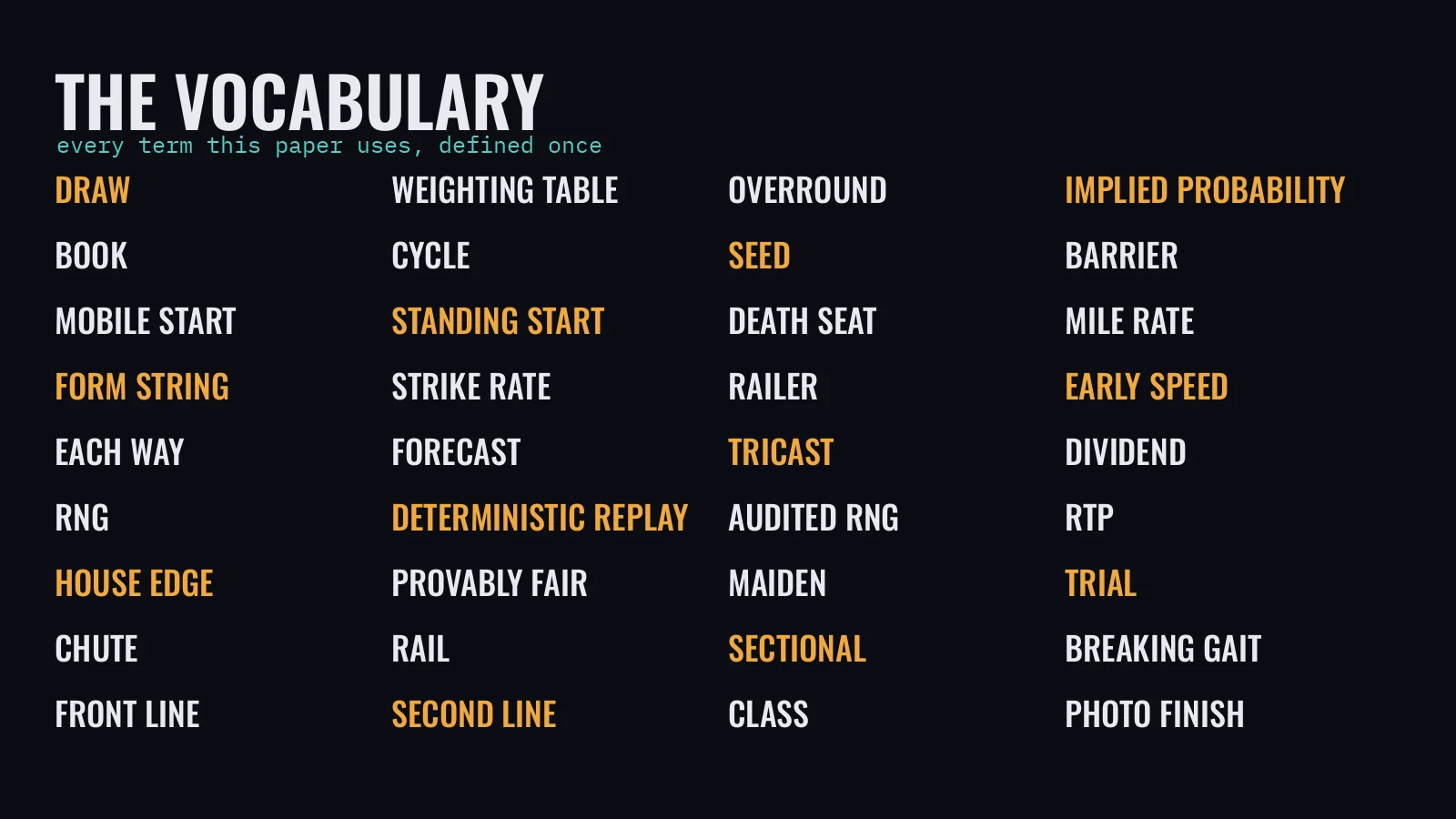
The glossary went up with 89 entries: 36 on the product, 34 on racing and 19 technical. That is a strange number of definitions for a subject this small, and the reason is simple. A Gallop Post survey of the sites that rank for virtual racing results, carried out on 18 October 2026, found no glossary on any of them — no definition page for forecast, tricast, starting price, each-way terms, the draw or the overround, on sites whose entire output consists of those words. The vocabulary was in daily use and written down nowhere.
The terms fall into three kinds, and the kind matters more than the group heading.
Words this circuit borrows
Harness racing has the best working vocabulary in the sport and the cards use it. The death seat is the spot directly outside the leader with no cover and all of the breeze, which Harness Racing New Zealand's glossary calls usually the toughest run in a race (read 18 October 2026). One-one is the horse behind it, with cover and handy. Second line is the row behind the front line, which Harness Racing Australia's rule 130(4) fills with the outside draws, as close as practicable behind (rules current to 17 July 2026).
Each of those entries ends the same way, and that ending is the editorial point: the phrase describes where the screen showed a runner, and the placing came out of the table. A borrowed word is allowed to describe the render. It is not allowed to explain the result.
Words this circuit refuses
Five entries exist to say that the term does not apply here, which is more useful than leaving a reader to wonder why a column is missing.
- Going and track rating. Racing Australia's ten-point scale has run since 1 December 2014 and a rating is determined on the day. Nothing on this circuit is determined on the day: the surface is a venue parameter, identical in the first race of the cycle and the last, so cards print the surface and stop.
- Starting price. There is no on-course market behind a simulated race and no late money to move a price, so every price is the one that was displayed. The data holds no key for an SP and the cards carry no column for it.
- Dead heat. A number is drawn once and the runner holding it leaves the pool, so two runners cannot share a placing. The validator rejects duplicate positions. Worth noting that this is not universal: GLI-33 v1.1 still requires an operator's house rules to cover dead heats, because a product whose result is computed by a physics engine genuinely can tie.
- Group and Listed. Black type is conferred by a principal racing authority. This circuit has none, so it has six classes — Feature, Class A, B, C, Maiden and Trial — and they are a programming ladder and nothing more.
Words that had to be written
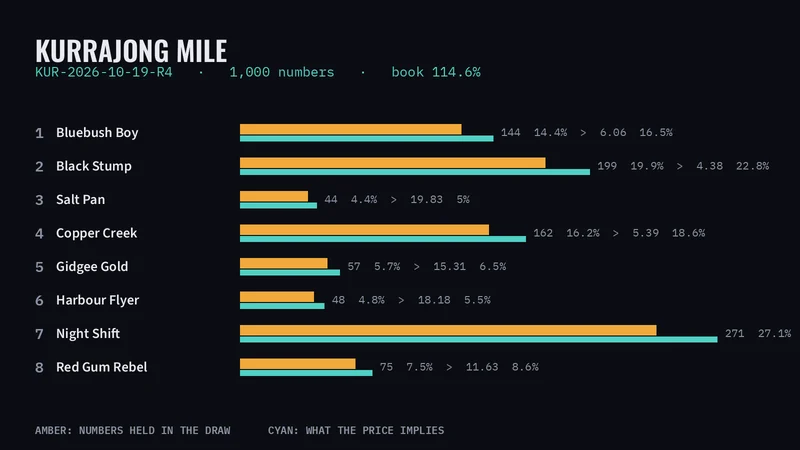
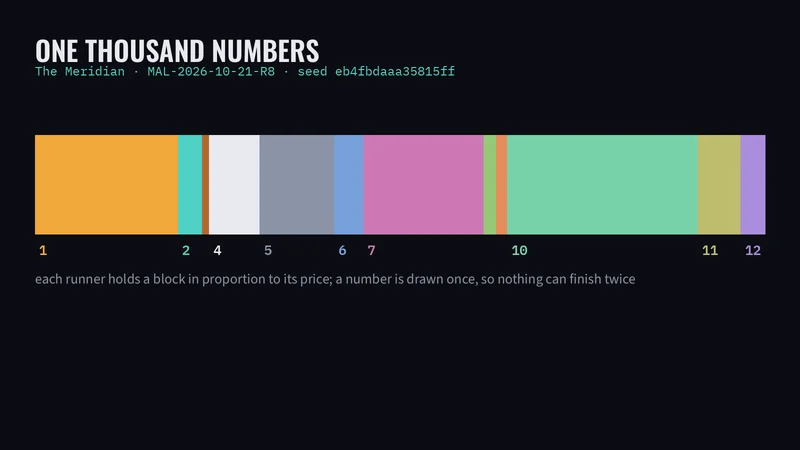
A handful had no published definition to borrow. Numbers held is the plainest of them: the block of numbers a runner holds in the draw, its chance written as a count rather than a price. The mechanic is described all over the niche — shorter-priced runners get more numbers, a bag of a thousand bingo balls, the same explanation relayed for years through affiliate pages — and nobody had given it a name you could put in a table header. Weighting table, draw id, published seed and settle are in the same position, and they are the columns this paper exists to print.
Where the sources disagree, the entry says so
Two examples. On cadence, published accounts of the commercial product give races every 3 minutes, every 3 to 5, every 4 to 5, every 9, every 15 and "every few minutes", and operating hours as both 8am to 10pm and 24 hours; one aggregator's own race counter reads 74 races per track per day while another account says about 100. On place terms, the clearest published statement is an archived affiliate page — 8 to 11 runners at 1/5 odds for three places, 12 to 15 at 1/4 odds for three, 16 or more at 1/4 odds for four — and Sky Bet's own rules use the same three bands with its own numbers (read 18 October 2026). Terms are a house choice, not a law of the format, and this circuit prints its own on every card.
Recording the disagreement is not hedging. In a niche where the authoritative results service is a client-side application with a locked interface, the honest state of knowledge is itself information. Every entry carries its source and the date it was read, and anything that rests on a single affiliate page is marked rather than promoted. The terms used across the circuit are linked from every section; the method they describe is on how-it-works.php.
Sources
- Harness Racing New Zealand — glossary: death seat, one-one, parked out, sprint lane read 18 Oct 2026
- Harness Racing Australia — Australian Harness Racing Rules, rules 130 and 142, current to 17 July 2026 read 18 Oct 2026
- Racing Australia — track ratings: ten-point scale introduced 1 December 2014, determined on the day read 18 Oct 2026
- Gaming Laboratories International — GLI-33 v1.1, Event Wagering Systems (revision date 14 May 2019): house rules must cover dead heats; reconstruction duty at §A.6 read 18 Oct 2026
- horseracingbuzz.net (archived) — place terms by runner band and the bingo-ball account of weighting read 18 Oct 2026
- Gallop Post survey of virtual racing sites — no glossary found on any of them read 18 Oct 2026
More from the desk
Reading a weighting table
Wren Tabakoff · 4 min
Why form cannot predict a draw
Mo Farrelly · 5 min

The circuit in a spreadsheet
Wren Tabakoff · 4 min
Comments (0)