Explainer
Reading a weighting table
Three sums turn a block of numbers into a published price. Worked all the way through on a real card, runner by runner.
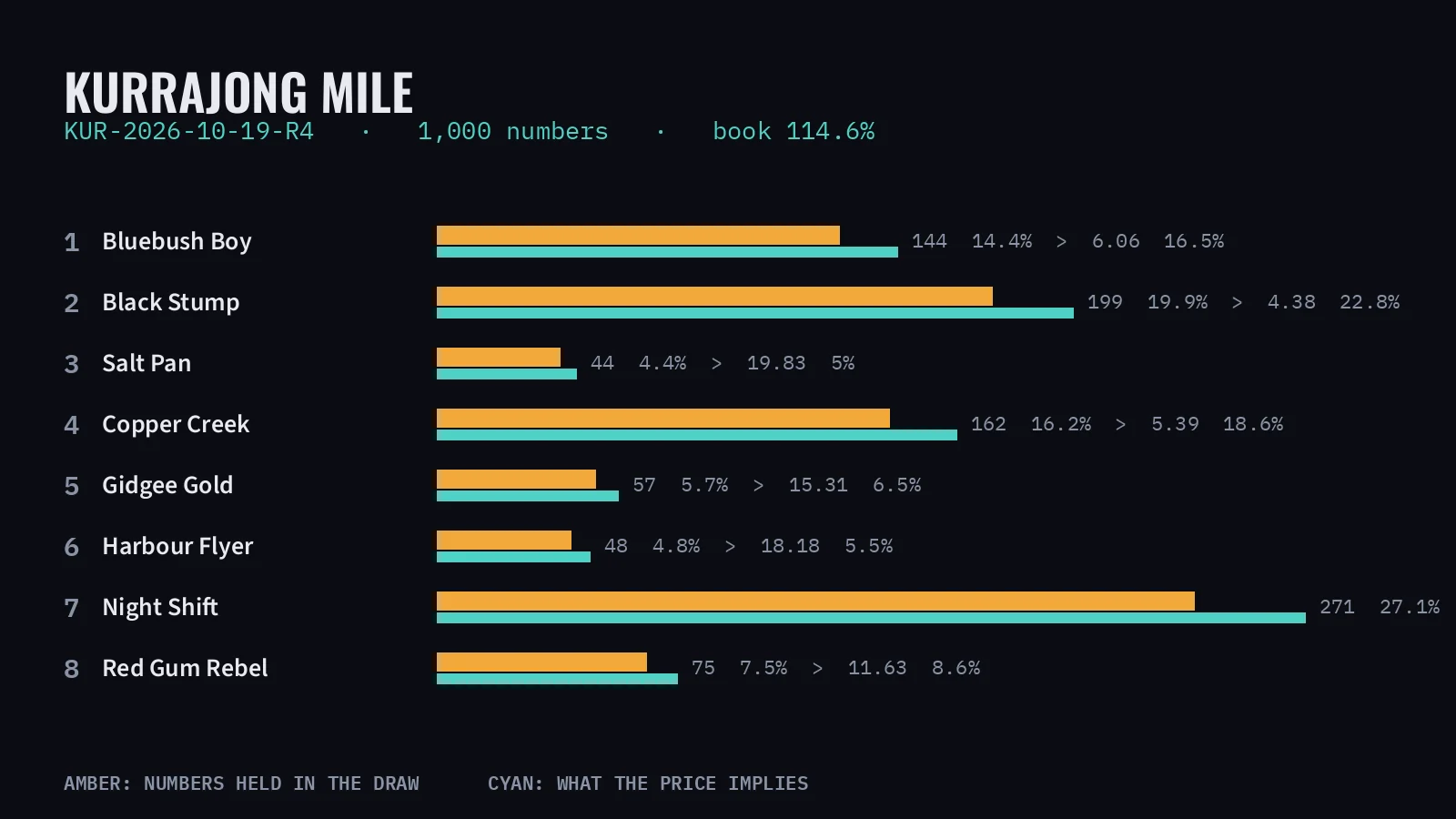
Every Gallop Post card prints a weighting table: the numbers each runner holds in the draw, the share of the draw that represents, the published price, and the percentage that price implies. The table is the race. Here is how to read one, worked on the Kurrajong Mile at Kurrajong Paceway, 1609 metres mobile, draw id KUR-R4-9FDFCB, book 114.6.
| No | Runner | Numbers held | Share | Price | Implied |
|---|---|---|---|---|---|
| 7 | Night Shift | 271 | 27.1% | 3.22 | 31.1% |
| 2 | Black Stump | 199 | 19.9% | 4.38 | 22.8% |
| 4 | Copper Creek | 162 | 16.2% | 5.39 | 18.6% |
| 1 | Bluebush Boy | 144 | 14.4% | 6.06 | 16.5% |
| 8 | Red Gum Rebel | 75 | 7.5% | 11.63 | 8.6% |
| 5 | Gidgee Gold | 57 | 5.7% | 15.31 | 6.5% |
| 6 | Harbour Flyer | 48 | 4.8% | 18.18 | 5.5% |
| 3 | Salt Pan | 44 | 4.4% | 19.83 | 5.0% |
| Total | 1,000 | 100.0% | 114.6% |
Step one: numbers to a share
The field is weighted out of 1,000 numbers and the blocks sum to exactly 1,000, so a runner's share of the draw is its numbers held divided by ten. Night Shift holds 271, which is 27.1 per cent. Salt Pan holds 44, which is 4.4 per cent. Night Shift holds 6.2 times as many numbers and wins 6.2 times as often. That is the entire forecast, and no other column adds to it.
Step two: the share to a price
If the prices matched the shares they would add to 100 and there would be no book. This card's book is 114.6, so the overround is 14.6 points. GP-Draw applies it as one flat multiplier: every share is multiplied by 1.146. Night Shift's 27.1 becomes 31.06. Salt Pan's 4.4 becomes 5.04.
Then invert. One hundred divided by 31.06 is 3.22, the price printed against Night Shift. One hundred divided by 5.04 is 19.84, printed as 19.83 once the arithmetic is carried to the second decimal rather than the rounded percentage. In a single line, for any runner on any card:
price = 100,000 ÷ (numbers held × book)
For Night Shift, 100,000 ÷ (271 × 114.6) = 3.22. The table is reproducible from two numbers and so is every price on it.
Step three: the margin, runner by runner
Because the shading is multiplicative, the gap between a runner's share and its implied percentage is proportional to the share. Multiply the share by 0.146. Night Shift gives up 4.0 points, from 27.1 to 31.1. Salt Pan gives up 0.6, from 4.4 to 5.0. The shortest price on the card carries nearly seven times the margin of the longest, measured in points, which is the ordinary shape of a commercial book and the reason the best-weighted runner is the worst-shaded one in almost every field.
Run it the other way for the price that would return exactly a runner's share: 1,000 divided by numbers held. Night Shift's 271 numbers are worth 3.69 against the 3.22 published. Salt Pan's 44 are worth 22.73 against 19.83. Printing both halves is the point of the paper; the margin is simply the distance between them, and Gallop Post holds none of it because it takes nothing.
What the book does across the circuit
Field size sets the book. Across the 21 cards on the published programme the ten eight-runner races average 116.22, the seven ten-runner races 120.50 and the four twelve-runner races 125.88 — 2.03, 2.05 and 2.16 points per runner. The trade rule of thumb, given in Wikipedia's article on virtual racing as about 2 per cent per runner and flagged on that page as needing a citation, holds here to within two tenths of a point (read 18 October 2026).
The smallest book on the programme is 114.4, on the Class B Sprint over 520 metres at Brolga Park. The largest is 127.0, on the Jacaranda Cup, twelve runners at Jacaranda Downs. Eight runners buy a tighter book than twelve, every time, for arithmetic reasons and no others.
One more thing the table gives you
A draw runs without replacement, so any exact finishing order has a computable chance. Night Shift then Black Stump: 27.1 per cent for the first leg, then Black Stump's 199 numbers against the 729 left once Night Shift's block has gone, which is 27.3 per cent. Multiply, and that pair in that order comes up 7.40 times in a hundred draws — about 13.52 to one. Resulted cards print Win, Place, Forecast and Tricast figures beside the finish as reference numbers, and the Win figure is always the winner's published price.
Prices on this circuit are the weighting in another notation. Nothing can be staked on them. The draw itself is set out step by step on how-it-works.php, and the terms used above are defined in the glossary.
Prices on this page are the draw weighting in another notation. They are reference figures published with the card, not odds available anywhere, and not a betting recommendation.
Sources
More from the desk
Why form cannot predict a draw
Mo Farrelly · 5 min
A glossary for a game with no glossary
Wren Tabakoff · 4 min

The circuit in a spreadsheet
Wren Tabakoff · 4 min
Comments (2)
Comments below the first rule arrived before this page moved to the current system and are reproduced as filed.
Ange_M
Checked the flat multiplier on three other cards and it holds on all of them. First site I have been able to do that on.
leftHandTurn
The fair-price column is the one I want printed on the card itself, not just in the explainer.