GallopPost The Virtual Racing Desk
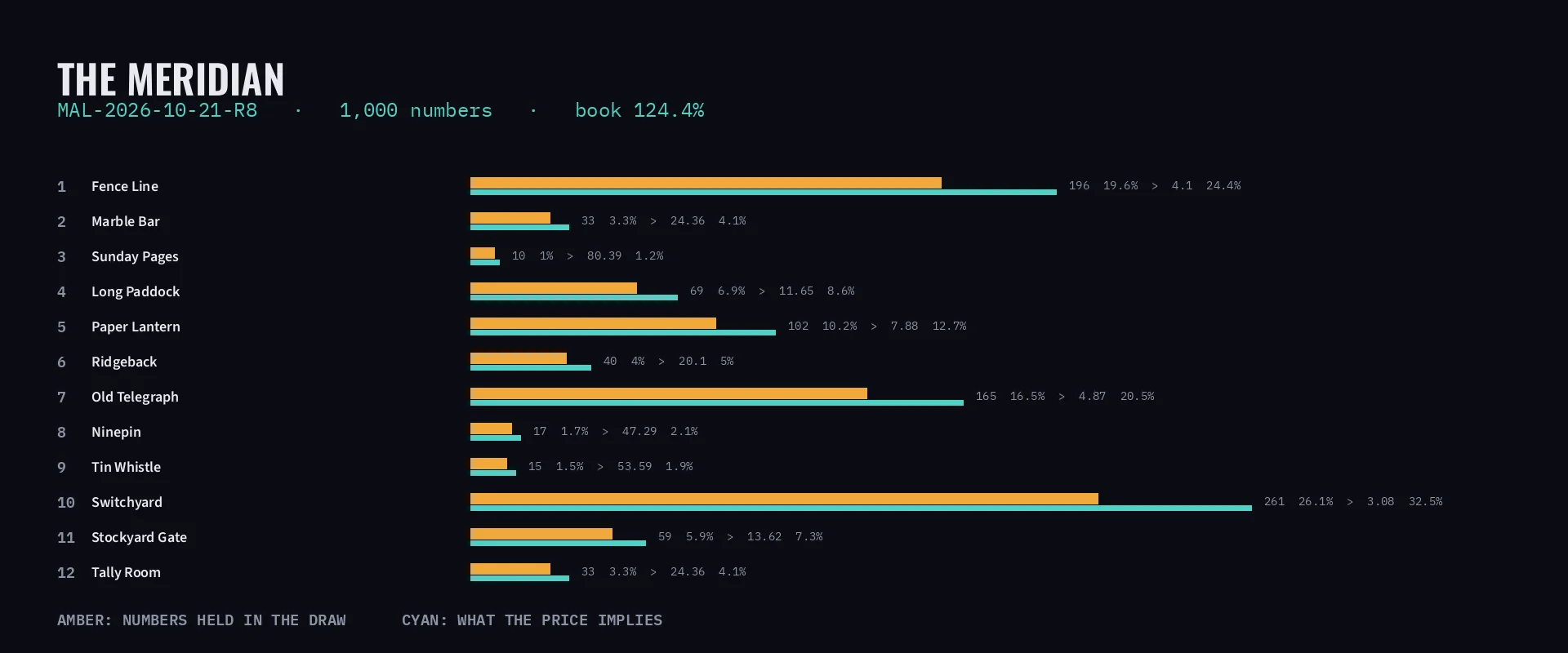
Generated weighting figure from the Gallop Post desk — twelve runners with an amber bar for the numbers each holds in the draw and a cyan bar for what its price implies

Reading the weightings

The form desk

8 columns on the cards still to run. Each one prints the numbers every named runner holds out of 1,000, the price that block was shaded to, and the gap between the two. None of it is a prediction: a weighted draw has no form to read.

  • 8Columns filed
  • 8Venues covered
  • 24Runners named
  • 26.4%Ledger strike

Form desk columns are editorial opinion only. They are not financial advice, not investment recommendations and not an inducement to wager. A weighted draw has no form to read in the predictive sense; what these columns argue about is the published weighting.

Gambling involves risk. If gambling is causing you harm, call Gambling Help on 1800 858 858 (free, 24/7) or visit gamblinghelponline.org.au.

What a column argues

as at 25 October 2026

A weighted draw has no form to read in the predictive sense. Every race on this circuit is settled by drawing numbers from a pool of 1,000 without replacement, and nothing in a runner's record changes the size of the block it holds. So nothing below is a prediction. What each column argues about is the weighting table the card published, which is a different thing and the only honest one available.

The arithmetic is the same on every card. The numbers a runner holds out of 1,000, divided by ten, are its true share of the draw, and a field's shares sum to 100. The published price is that share shaded by the book, and the implied percentage is 100 divided by the price. The gap between the two is the margin, and it is where most of the words below go.

8 columns are filed below, across 8 venues and 4 codes, newest first. Each names three runners — the top of the market, the thinnest part of the book and the outsider — and prints the block, the price and the implied percentage beside every one. Figures are as at 25 October 2026 on the circuit clock, and the day a card sits on is resolved against that date every time this page is served.

Prices on this page are the draw weighting in another notation. They are reference figures published with the card, not odds available anywhere, and not a betting recommendation.

Showing 8 of 8 columns. Filtering happens in the browser; with scripting off every column is on the page below, under the day its card is drawn.

Wednesday 28 October 2026

in 3 days · 2 columns

In 3 days · 28 October · thin read

Bellbird Steeple

Bellbird Rise · Jumps · Feature · · 4200m · book 116.5%

Gus Abernethy, Industry reporter · filed

  • Top of the market

    Sour Face

    3.76 228 numbers · 22.8% true · 26.6% implied

    Holds 228 numbers for 22.8 per cent, the largest block on the card. It has no record on this circuit, so its form string and career record both print a dash.

  • Where the book is thinnest

    Half Mast

    4.13 208 numbers · 20.8% true · 24.2% implied

    Two hundred and eight numbers for 20.8 per cent, and the same price as Rail Spike, which holds the same 208. Identical blocks produce identical prices, because a price is the block in another notation.

  • The outsider

    Stockyard Gate

    35.77 24 numbers · 2.4% true · 2.8% implied

    Twenty-four numbers, its thinnest block on the published programme, against 317 at Coorong Park tomorrow night. Three of its last five starts were wins and none of that is in the table.

The house line, which this column does not skip: the result is drawn from a weighted table, so form has no predictive power over it, and what follows is an argument about the table. The Bellbird Steeple is 4200 metres over nine fences at Bellbird Rise at 1.50pm in three days, draw id BEL-R4-A7126A, book 116.5. It is the longest distance on the circuit.

Filed as thin, because three runners sit within 20 numbers of the top. Sour Face holds 228, Half Mast 208 and Rail Spike 208. The last two are printed at the same $4.13 for the same 24.2 per cent implied, which is the clearest demonstration on the programme that the price carries no information the weighting table has not already given.

Four of the eight have no record on this circuit. Sour Face, Rail Spike, Prize Galleon on 131 and Frontier Town on 56 hold 623 of the 1,000 between them; the four with records hold 377. The 16.5 points of overround are applied as one multiplier of 1.165, so Sour Face's 22.8 per cent reads as 26.6, a margin of 3.8 points, and Stockyard Gate's 2.4 reads as 2.8, a margin of 0.4. The shading is proportional and the points fall on the thick blocks, which is all that question ever means here.

There is no jumping model behind any of this. The nine fences are rendered and the finishing order is drawn, so no runner falls at Bellbird Rise and the fence count changes the picture and not the probabilities. For comparison in the real product: portmanparkresults.com describes Steepledowns, the jumps venue in the 49's virtual feed, as a left-handed circuit of eight fences with a water jump, racing from two miles to two miles four furlongs (read 18 October 2026). Bellbird Rise has nine fences, no water and metric distances.

The last jumps card here is the one to read beside this table. Six days ago over 3200 metres, Southern Split held 342 numbers, the second-largest block the programme has published, and finished third at 3.8 lengths. Idle Dream won it off 141 numbers, returning $6.03. Stockyard Gate was fourth that day off 153 and holds 24 this time.

The field, the weighting table and the seed for the Bellbird Steeple →

In 3 days · 28 October · balanced read

Maiden Flat

Mallee Park · Thoroughbred · Maiden · · 1200m · book 119.5%

Wren Tabakoff, Editor · filed

  • Top of the market

    Dry Lightning

    3.55 236 numbers · 23.6% true · 28.2% implied

    Holds 236 numbers for 23.6 per cent, the largest block in a maiden whose ten runners have 61 career wins between them. Seven of those 61 are its own.

  • Where the book is thinnest

    Ridgeback

    3.95 212 numbers · 21.2% true · 25.3% implied

    Two hundred and twelve numbers for 21.2 per cent, twenty-four fewer than the top block. The same horse holds 281 in the Jacaranda Cup the day before.

  • The outsider

    Ninepin

    44.08 19 numbers · 1.9% true · 2.3% implied

    Nineteen numbers for 1.9 per cent, the thinnest block on the card. Forty-three starts for four wins and ten seconds is a record of draws, not a tendency.

As ever: the draw is weighted and independent, no form reads forward into it, and this column argues about the published numbers instead of predicting the finish. The Maiden Flat is race one at Mallee Park, 1200 metres from the chute at 12.46pm in three days, draw id MAL-R1-3FF9AC, book 119.5.

Start with the word on the card. Maiden here is a class label the programme attaches to a race, not a statement about the field, and every one of these ten runners has won races. Between them they have 61 career wins. Pennyroyal has thirteen from 49 starts and the best career strike rate in the field at 26.5 per cent, and it holds 35 numbers, the fourth-thinnest block. There is no eligibility rule being bent, because there is no eligibility rule: how it works explains why class on this circuit describes the card and not the runner.

The 19.5 points of overround are applied as one multiplier of 1.195. Dry Lightning's 23.6 per cent becomes an implied 28.2, a margin of 4.6 points. Ninepin's 1.9 becomes 2.3, a margin of 0.4. The three thickest blocks — Dry Lightning 236, Ridgeback 212, Bitumen 188 — hold 636 of the 1,000 and absorb 4.6, 4.1 and 3.7 points. Everybody else gives up 1.7 or less.

The card also shows what a price is for. Marble Bar and Old Telegraph hold 31 numbers each, and both are printed at $27.02 for 3.7 per cent. They have eleven career wins between them, won in different places at different prices, and the table does not know and does not care. Identical blocks, identical prices.

One more line against the form. Bitumen has three wins from 34 starts, the weakest career strike rate in the field at 8.8 per cent, and holds the third block on 188 numbers. A 1200-metre Mallee Park card starts in the chute and runs to the 400-metre straight, which changes what the screen shows and nothing in the table.

The field, the weighting table and the seed for the Maiden Flat →

Tuesday 27 October 2026

in 2 days · 1 column

In 2 days · 27 October · balanced read

Jacaranda Cup

Jacaranda Downs · Thoroughbred · Feature · · 2400m · book 127.0%

Wren Tabakoff, Editor · filed

  • Top of the market

    Ridgeback

    2.80 281 numbers · 28.1% true · 35.7% implied

    Holds 281 numbers for 28.1 per cent, the largest block on the card, and carries the largest single-runner margin on the programme at 7.6 points. Its last four starts read 5-9-8-0, which has no bearing on the draw.

  • Where the book is thinnest

    Old Telegraph

    5.12 154 numbers · 15.4% true · 19.5% implied

    One hundred and fifty-four numbers for 15.4 per cent, second of twelve in the table. It was second in the Handicap Hurdle at Bellbird Rise six days ago off 177 numbers at $4.80.

  • The outsider

    Marble Bar

    98.50 8 numbers · 0.8% true · 1.0% implied

    Eight numbers of the 1,000, the thinnest block on any published card, and the only price above $98 on the programme. Six career wins from 29 starts sit beside it and count for nothing.

The house position, before the sums: a weighted draw has no form to read forward, and what follows is an argument about the published weighting table rather than a prediction of the result. The Jacaranda Cup is 2400 metres right-handed at Jacaranda Downs at 3.10pm in two days, draw id JAC-R5-4D9D09, book 127.0 — the largest of the 21 cards the programme has published.

This is also the card the postbag is about. Ridgeback holds 281 numbers with three career wins from sixteen starts, while Paper Lantern has thirteen from 57 and holds 44. The card is not broken and the reasoning is set out at length in the weighting that looks wrong. Previous results are a record of previous draws, and the engine has no field in which to put them.

Now the arithmetic, which is the part worth the reader's time. Twenty-seven points of overround across twelve runners, against the circuit's own pattern of roughly 100 plus two points a runner, means this card carries about three points more than the pattern. The multiplier is 1.270 and it is the same for everybody. Ridgeback's 28.1 per cent becomes an implied 35.7, a margin of 7.6 points. Marble Bar's 0.8 becomes 1.0, a margin of 0.2.

Which runners is the book shading hardest? In proportion, none: the shading is one flat multiplier, which is the practice this desk prints rather than infers. In points it is the top of the market, necessarily. Ridgeback, Old Telegraph and Stockyard Gate hold 571 of the 1,000 between them and absorb 7.6, 4.1 and 3.7 points of margin. The six runners under 50 numbers give up 1.2 points or less each.

Two footnotes for anyone keeping a record. Stockyard Gate has won three of its last five and holds the fourth block here, 136 numbers. Ridgeback's trainer Hugh Pentland also saddles Tally Room, which has eight career wins and 41 numbers, the fifth-thinnest block in the field. And 2400 metres at Jacaranda Downs is a lap and a half of the circuit's biggest ring, 2100 metres around and the only right-handed gallops track on the circuit.

The field, the weighting table and the seed for the Jacaranda Cup →

Monday 26 October 2026

tomorrow · 2 columns

Tomorrow · 26 October · firm read

Gidgee Pace

Gidgee Paceway · Harness · Feature · · 1660m · book 118.4%

Mo Farrelly, Form desk · filed

  • Top of the market

    Harbour Flyer

    2.50 338 numbers · 33.8% true · 40.0% implied

    Holds 338 numbers for 33.8 per cent, and 40.0 per cent implied is the largest on any card still to run bar its own 40.8 at Kurrajong tonight. It won at this venue three days ago over 2240 metres from a standing start, off 165 numbers at $5.29.

  • Where the book is thinnest

    Salt Pan

    3.74 226 numbers · 22.6% true · 26.7% implied

    Two hundred and twenty-six numbers for 22.6 per cent, after finishing last of eight at Kurrajong yesterday off 44. The block is 5.1 times thicker and the horse is the same horse.

  • The outsider

    Night Shift

    27.29 31 numbers · 3.1% true · 3.7% implied

    Thirty-one numbers for 3.1 per cent, the thinnest block in the field. The same pacer holds 271 at Kurrajong on the card a day earlier, 8.7 times more.

No form reads forward into a weighted draw, so take what follows as an argument about the published weighting and not a forecast. The Gidgee Pace is 1660 metres from a mobile start on the 805-metre clay half-mile at Gidgee Paceway at 8.28pm tomorrow, draw id GID-R6-2205E9, book 118.4.

Filed as firm. Harbour Flyer on 338 and Salt Pan on 226 hold 564 of the 1,000 numbers between them, and the other six share 436. The top block is 10.9 times the thinnest. The 18.4 points of overround go on as one multiplier of 1.184, so Harbour Flyer's 33.8 per cent reads as an implied 40.0, a margin of 6.2 points, and Night Shift's 3.1 reads as 3.7, a margin of 0.6. Only one implied percentage still to run is larger, and it is Harbour Flyer's own 40.8 at Kurrajong tonight.

The comparison worth making is with the Kurrajong Mile tonight, because it is the same eight pacers in the same field size. That card's book is 114.6 and this one is 118.4, so the same eight names carry 3.8 points more overround tomorrow than they do tonight. The engine did not form a view about the horses. It published two tables.

Inside the field the career column and the weighting column disagree, as usual. Gidgee Gold has the best career strike rate of the eight pacers at 25.7 per cent and holds the fifth block, 108 numbers. Night Shift has the lowest at 12.7 per cent and held the largest block in the circuit's premier harness race a day earlier. Salt Pan was beaten fourteen lengths yesterday and is second in this table.

Sam Oyelaran drives the top block, from two drives for no win and one third. One practical note about the venue: at 805 metres around, a 1660-metre mobile is a shade over two laps and the field passes the post twice, so check the lap count before reading a sectional off this card.

The field, the weighting table and the seed for the Gidgee Pace →

Tomorrow · 26 October · firm read

Tin Creek Classic

Tin Creek · Thoroughbred · Feature · · 1600m · book 119.5%

Mo Farrelly, Form desk · filed

  • Top of the market

    Sunday Pages

    2.56 327 numbers · 32.7% true · 39.1% implied

    Holds 327 numbers for 32.7 per cent, 2.1 times the next block in the field. Its 6.4-point margin is equal third-largest of the cards still to run.

  • Where the book is thinnest

    Dry Lightning

    5.70 147 numbers · 14.7% true · 17.5% implied

    One hundred and forty-seven numbers for 14.7 per cent. It was second in the Class C Sprint at Saltbush Flat two days ago, beaten 1.8 lengths off 185 numbers at $4.28.

  • The outsider

    Half Mast

    32.21 26 numbers · 2.6% true · 3.1% implied

    Won that same Saltbush Flat sprint off 210 numbers, returning $3.77, and holds 26 here — a block eight times thinner. Nothing carried over, because on this circuit nothing can.

Stated once, as every column states it: the draw is weighted and independent, so there is no form to read forward, and this is an argument about the numbers the card publishes. The Tin Creek Classic is 1600 metres on the synthetic at Tin Creek at 4.02pm tomorrow, draw id TIN-R7-D2A1B6, book 119.5 across ten.

The desk files this one as firm because the weighting table separates one runner from the field. Sunday Pages holds 327 of the 1,000 numbers. The next two blocks are Tally Room on 157 and Dry Lightning on 147, and the thinnest is Bitumen on 15, so the top block is 21.8 times the bottom one. Only two larger blocks are still to run, both of them Harbour Flyer's: 352 at Kurrajong tonight and 338 at Gidgee tomorrow.

The 19.5 points of overround are applied as a single multiplier of 1.195, which puts Sunday Pages's 32.7 per cent at an implied 39.1 and Bitumen's 1.5 at 1.8. The margins are 6.4 points and 0.3 points for the same proportional shading, which is the whole mechanism: the book is shading the top of the market hardest only in the sense that the top of the market is where the numbers are. Tally Room gives up 3.1 and Dry Lightning 2.8.

Sunday Pages has 46 starts for eleven wins, a career strike rate of 23.9 per cent, and a form string reading 1-8-7-8-5. Four days ago on this same synthetic it was seventh of ten off 29 numbers at $28.86, beaten eleven lengths. Tomorrow it holds 327. Both figures are correct and neither explains the other.

Ruby Nankervis rides the top block, from five rides on the resulted programme for no win, one second and two thirds. Tin Creek is the only venue on the circuit that races around the clock — 297 races in 24 hours — and the only one whose surface never changes, so there is no going line on this card and never will be.

The field, the weighting table and the seed for the Tin Creek Classic →

Sunday 25 October 2026

today · 3 columns

Today · 25 October · thin read

Brolga Dash

Brolga Park · Greyhound · Feature · · 520m · book 115.6%

Mo Farrelly, Form desk · filed

  • Top of the market

    Quick Sticks

    4.12 210 numbers · 21.0% true · 24.3% implied

    Holds 210 numbers for 21.0 per cent, the largest block in the flattest field on the programme. Six numbers separate it from Tin Lid, which has no record on this circuit at all.

  • Where the book is thinnest

    Saltbush Sal

    5.48 158 numbers · 15.8% true · 18.2% implied

    Won over this course and distance two days ago off 65 numbers, returning $13.44, and holds 158 tonight. Its career strike rate of 9.3 per cent is the lowest of the four greyhounds carrying a record.

  • The outsider

    Spinifex Lad

    13.95 62 numbers · 6.2% true · 7.2% implied

    Sixty-two numbers for 6.2 per cent, sixth of eight in the weighting. Its 24.3 per cent career strike rate is the best in the field, which is a fact about past draws and nothing else.

The house position first, because it governs the rest: a weighted draw carries no form in the predictive sense, and what follows argues about the published weighting rather than forecasting the result. The Brolga Dash is 520 metres out of eight boxes at Brolga Park at 9.17pm, draw id BRO-R8-CA5696, book 115.6.

This is the flattest field still to run. The blocks run from 37 to 210, a 5.7-fold spread, where the Jacaranda Cup in two days runs from 8 to 281, a spread of 35-fold. The desk files this one as thin for that reason: the top four blocks hold 751 of the 1,000 and the bottom four hold 249, and there is no runner the table sets apart.

Four of the eight have no record on the circuit. Tin Lid holds 204 numbers, Dusty Boots 179, Four Mile 78 and Gummy Shark 37 — 498 between them, very nearly half the draw, with a dash in the form string and a dash in the record. The four with a record hold 502. Readers who want a card where the form column is simply absent should start here.

The 15.6 points of overround go on as one multiplier of 1.156, so Quick Sticks's 21.0 per cent becomes an implied 24.3, a margin of 3.3 points, and Gummy Shark's 3.7 becomes 4.3, a margin of 0.6. Nobody is shaded harder than anybody else in proportion. In points it is Quick Sticks, Tin Lid at 3.2 and Dusty Boots at 2.8, in that order, because that is the order of the blocks.

The last running here is the useful corrective. Two days ago over the same 520 metres Brindle Jack held 241 numbers, the largest block in the field, and finished last of eight at 13 lengths. Saltbush Sal won it off 65. Brindle Jack holds 72 tonight and Saltbush Sal holds 158, and neither figure was moved by what the screen showed.

The field, the weighting table and the seed for the Brolga Dash →

Today · 25 October · balanced read

Kurrajong Mile

Kurrajong Paceway · Harness · Feature · · 1609m · book 114.6%

Ilsa Brandt, Games and culture · filed

  • Top of the market

    Night Shift

    3.22 271 numbers · 27.1% true · 31.1% implied

    Holds 271 numbers of the 1,000, 27.1 per cent, and the largest block in the demo field. Its career strike rate of 12.7 per cent is the lowest of the eight pacers, and that is a log of past draws rather than an input to this one.

  • Where the book is thinnest

    Black Stump

    4.38 199 numbers · 19.9% true · 22.8% implied

    One hundred and ninety-nine numbers for 19.9 per cent. Its career strike rate of 22.8 per cent matches its implied percentage to the decimal, which means nothing at all and is too neat to leave out.

  • The outsider

    Salt Pan

    19.83 44 numbers · 4.4% true · 5.0% implied

    Forty-four numbers for 4.4 per cent, carrying the smallest margin on the card at 0.6 points. Marnie Kessel drives it from barrier three, the only barrier the programme has given her.

Form has no predictive power over an independent draw, so this is a reading of the published weights and not a tip on what will happen. The Kurrajong Mile is 1609 metres from a mobile start at Kurrajong Paceway at 7.42pm, draw id KUR-R4-9FDFCB, book 114.6.

That book is the smallest of the thirteen cards still to run, and the third-smallest of the 21 the programme has published. The circuit's own pattern is about 100 plus two points a runner, which for eight runners would be 116, so this card carries 1.4 points less overround than the pattern. The multiplier is 1.146 and it is applied to everybody: Night Shift's 27.1 per cent becomes an implied 31.1, a margin of 4.0 points, and Salt Pan's 4.4 becomes 5.0, a margin of 0.6.

In points, then, the book shades the top of the market hardest and in proportion it shades nobody. Night Shift gives up 4.0, Black Stump 2.9 and Copper Creek 2.4. The four runners under 80 numbers give up 1.1 points or less. The sums are worked line by line on this same card in reading a weighting table.

These eight are the eight runners in the free play-credit game at play/, in their own liveries, which is why the Mile is the card to read first if you have never seen a virtual race. Play credits only: nothing to win and nothing to lose. Night Shift carries number seven on this card, in purple and white.

One cross-card number is worth keeping. Night Shift holds 271 here and 31 in the Gidgee Pace tomorrow night, 8.7 times fewer, on a card a day later. Harbour Flyer goes the other way: 48 numbers in the Mile and 352 in the Class B Mobile Pace twenty-four minutes afterwards, at 8.06pm, which is the largest block the programme has published. Two cards, one field, and no line of continuity between them.

The field, the weighting table and the seed for the Kurrajong Mile →

Today · 25 October · balanced read

Saltbush Dash

Saltbush Flat · Thoroughbred · Feature · · 1200m · book 125.8%

Mo Farrelly, Form desk · filed

  • Top of the market

    Stockyard Gate

    3.07 259 numbers · 25.9% true · 32.6% implied

    Holds 259 of the 1,000 numbers, 25.9 per cent of the draw and the largest block in a field of twelve. The three wins in its last five starts came off blocks of 67, 152 and 20, which is the whole of what a form string means here.

  • Where the book is thinnest

    Pennyroyal

    8.46 94 numbers · 9.4% true · 11.8% implied

    Ninety-four numbers for 9.4 per cent, and the best career strike rate in the field at 26.5 per cent. It was last of twelve over this course two days ago off thirteen numbers.

  • The outsider

    Tally Room

    88.39 9 numbers · 0.9% true · 1.1% implied

    Nine numbers of the 1,000, the thinnest block on the card, against a career strike rate of 23.5 per cent. It is the second-longest price on the thirteen cards still to run.

A weighted draw has no form to read in the predictive sense, so nothing below is a prediction: it is an argument about the published weighting table, which is a different thing and the only honest one available. The Saltbush Dash runs 1200 metres in a straight line at Saltbush Flat at 3.24pm, draw id SAL-R6-AC8738, with a book of 125.8 across twelve runners. That is the second-largest book of the thirteen cards still to run, and the arithmetic starts there.

The blocks sum to exactly 1,000 and the field's true shares therefore sum to 100. The published prices sum to 125.8, so 25.8 points of overround sit on top. GP-Draw applies it as one flat multiplier of 1.258. Stockyard Gate's 25.9 per cent becomes an implied 32.6, a margin of 6.7 points. Tally Room's 0.9 becomes 1.1, a margin of 0.2.

So the answer to the question readers keep sending is that nobody is singled out. The proportion is identical all the way down the card and the points of margin land where the numbers are. In points the book shades Stockyard Gate and Paper Lantern hardest, 6.7 and 5.6, because those two hold 477 of the 1,000 between them. The nine runners holding fewer than 100 numbers give up 2.4 points or less each.

The career column argues the other way and has no vote. Pennyroyal has thirteen wins from 49 starts and holds 94 numbers. Tally Room has eight from 34 and holds nine. Paper Lantern has thirteen from 57 and holds 218, which is the one line on the card where the two columns agree, and the agreement is a coincidence. The reasoning is set out in full in why form cannot predict a draw.

Cleo Baird rides the top block. She has had five rides on the resulted programme for no win and one third, which is a count of five draws and not a trend. Stockyard Gate is the better illustration: three wins in its last five, off 67, 152 and 20 numbers, returning $12.78, $5.51 and $40.78. Same horse, three books, three entirely different blocks — the account is in this report.

The field, the weighting table and the seed for the Saltbush Dash →

The desk ledger

as at 25 October 2026

Every column names a top pick. The ledger counts how many of those picks came out of the draw first on the cards that have since been drawn, by columnist, and prints nothing else. It is a count of draws the desk happened to name. It is not evidence of a method, and no advantage over a weighted random draw is claimed anywhere on this site.

Top picks only, counted against the cards that have since been drawn. Strike rate is winners divided by columns.
Columnist Desk Columns Winners Strike
Mo Farrelly Form desk 46 12 26.1%
Wren Tabakoff Editor 22 6 27.3%
Ilsa Brandt Games and culture 11 3 27.3%
Gus Abernethy Industry reporter 8 2 25.0%

There is no return column in this ledger and there will not be one. Nothing is staked on a Gallop Post card — the circuit takes no bets, holds no accounts and pays nothing out — so there is no return to report, and any figure in that column would have to be invented. Across the 87 columns counted here, 23 top picks were drawn first, a strike rate of 26.4%.

What each line is worth

Mo Farrelly — Top picks only, counted against the cards that have since been drawn. The top block on a published Gallop Post card averages 27.4 per cent of the draw, so a strike rate near that figure is what picking top blocks produces and nothing more.

Wren Tabakoff — No advantage over a weighted random draw is claimed here, and none is available: the ledger is a count of draws the desk happened to name, not evidence of a method.

Ilsa Brandt — Eleven columns is too small a sample to carry a decimal point, and it is printed because hiding it would be worse.

Gus Abernethy — There is no return column in this ledger. Nothing is staked on a Gallop Post column, so there is no return to report, and any figure in that column would have to be invented.

Form desk columns are editorial opinion only. They are not financial advice, not investment recommendations and not an inducement to wager. A weighted draw has no form to read in the predictive sense; what these columns argue about is the published weighting.

Gambling involves risk. If gambling is causing you harm, call Gambling Help on 1800 858 858 (free, 24/7) or visit gamblinghelponline.org.au.

The circuit wrap

Friday mornings: the week's results, the weightings that moved, and anything the industry did worth reading about.