What a virtual race is
as at 25 October 2026 · engine GP-Draw 4.2
A virtual race is a picture of a draw. Nothing runs, nothing tires and nothing tries. The result is selected first and the animation is built afterwards to show it.
Wikipedia's article on virtual racing describes the commercial product as "a visual representation of a computerised random number draw" (read 18 October 2026). That article is flagged for sourcing and its only reference is a bookmaker's staff manual, so read it as the industry describing itself. It is still exactly accurate about this circuit.
The compliance version is GLI-33 v1.1, Gaming Laboratories International's event-wagering standard, revision date 14 May 2019. Its section 4.5 requires a virtual event result to come from an approved random number generator, and forbids the outcome being ascertainable before the event begins.
Gallop Post runs 10 simulated venues under GP-Draw 4.2. It takes no bets. Every figure below is read off a card published on this site.
The draw, in five steps
without replacement · 1,000 numbers
- The card is published. A race is generated whole — field, saddlecloths, barriers, prices and weighting table. Nothing is added or withdrawn afterwards.
- Each runner is given a block of numbers. The draw holds 1,000 numbers and a block is proportional to the runner's price: the shorter the price, the larger the block. The blocks sum to 1,000, so some runner always wins.
- One number is drawn. The runner holding it wins. That is the whole of the first placing.
- The winner leaves the pool. The draw runs without replacement, so the winning block goes with it and second place is drawn from the survivors in proportion to what they still hold. The virtual-racing patents describe that renormalisation directly: the remaining portions are readjusted after each runner is drawn (US 6,921,331 and US 7,291,070).
- Repeat until the field is ordered. The engine records the seed, the draw id, the drawn order and the settle time, then hands the order to the renderer.
A worked card
KUR-R4-9FDFCB · book 114.6%
The Kurrajong Mile is
1609m mobile at
Kurrajong Paceway,
today at 7.42pm. It is
draw KUR-R4-9FDFCB, seed
9fdfcb9f663c7980, and the table below is the race.
| No | Runner | Numbers held | Share of the draw | Price | Price implies |
|---|---|---|---|---|---|
| 7 | Night Shift | 271 | 27.1% | 3.22 | 31.1% |
| 2 | Black Stump | 199 | 19.9% | 4.38 | 22.8% |
| 4 | Copper Creek | 162 | 16.2% | 5.39 | 18.6% |
| 1 | Bluebush Boy | 144 | 14.4% | 6.06 | 16.5% |
| 8 | Red Gum Rebel | 75 | 7.5% | 11.63 | 8.6% |
| 5 | Gidgee Gold | 57 | 5.7% | 15.31 | 6.5% |
| 6 | Harbour Flyer | 48 | 4.8% | 18.18 | 5.5% |
| 3 | Salt Pan | 44 | 4.4% | 19.83 | 5.0% |
| Total | 1,000 | 100.0% | — | 114.6% | |
Scroll the table sideways to see every column.
Prices on this page are the draw weighting in another notation. They are reference figures published with the card, not odds available anywhere, and not a betting recommendation.
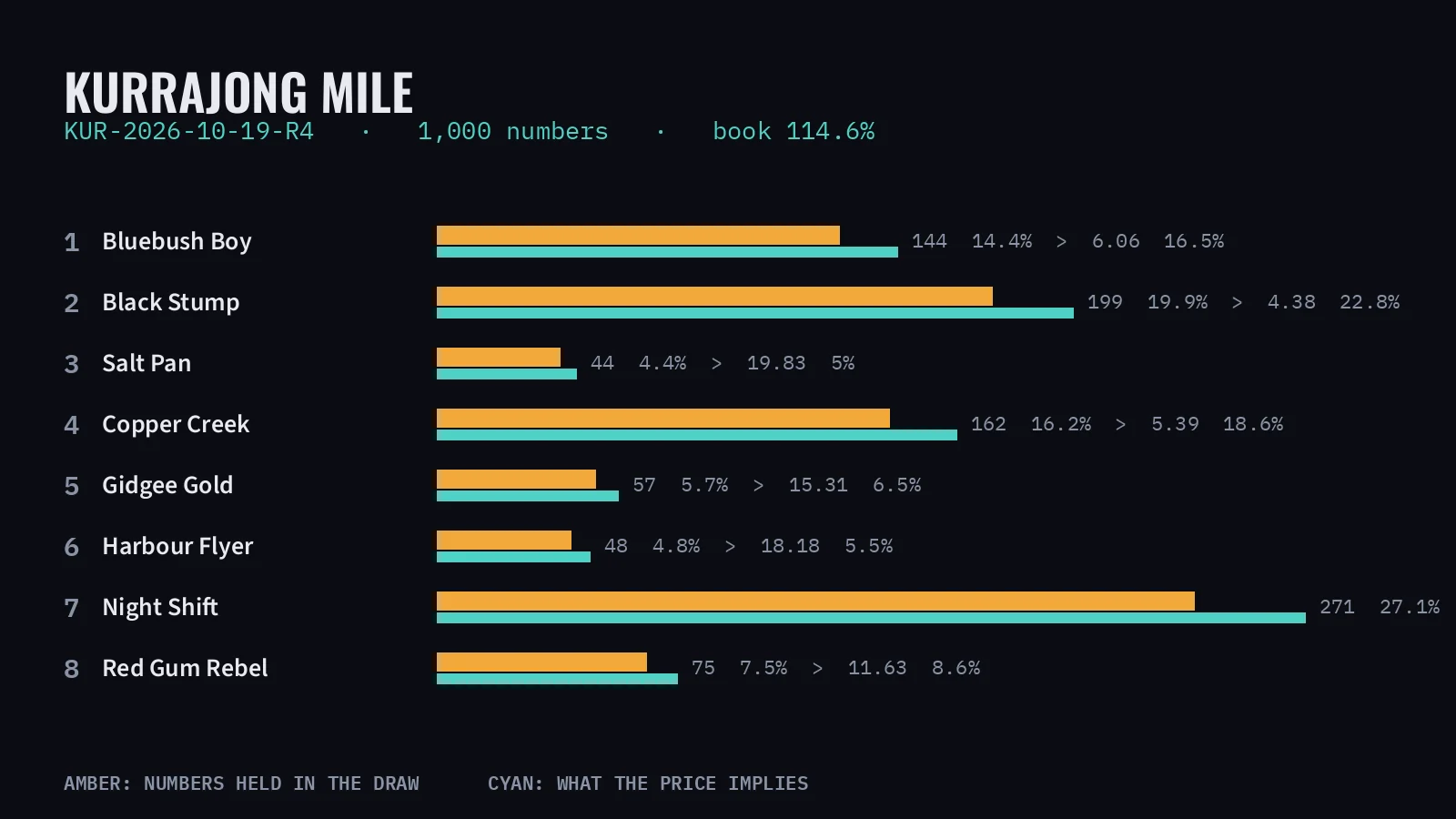
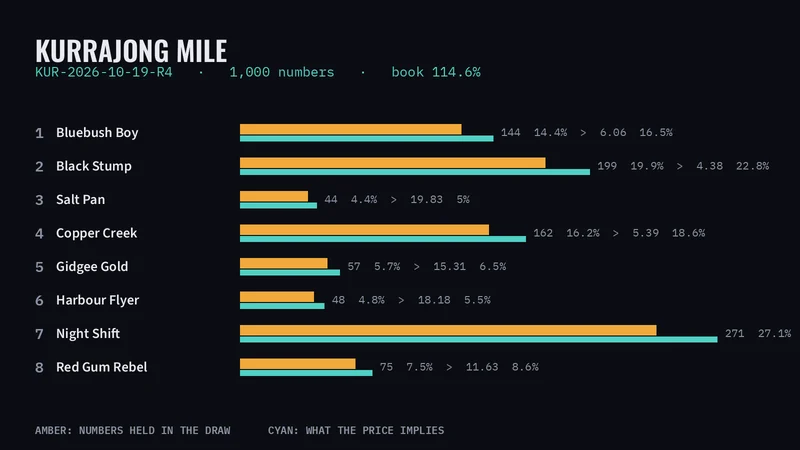
Read the third column first. Night Shift holds 271 numbers of the 1,000, so it wins 27.1 per cent of draws. Salt Pan holds 44 and wins 4.4 per cent. One holds 6.2 times as many numbers as the other and wins 6.2 times as often. No other column on the card adds anything to that.
The price is the share with the book applied: every share is multiplied by 1.146 and inverted. In one line, for any runner on any card:
price = 100,000 ÷ (numbers held ×
          book)
For Night Shift: 100,000 ÷ (271 × 114.6) = 3.22, the price printed against it. For Salt Pan: 100,000 ÷ (44 × 114.6) = 19.83. The runner-by-runner working is in Reading a weighting table.
The animation is the last thing that happens
render, not cause
The finishing order exists before the first frame. Margins, sectionals, the mile rate and the photo finish are drawn to fit it. Betradar lists a photo finish among its Virtual Horses features (page read 18 October 2026); it is a camera pointed at a decision already taken.
Every habit a racing reader brings to a card works against it. A barrier holds no numbers. A livery holds no numbers. A driver holds no numbers — and the drivers, jockeys and trainers on this circuit are engine personae, names attached to the silks, which the paper states once here and once on people.
The Class B Flat at Mallee Park, drawn yesterday, is the demonstration. Stockyard Gate held 20 numbers of the 1,000 — 2.0 per cent of the draw — and won at 40.78. Bitumen held 315, the largest block in the field, and finished 4th. The screen showed the 40.78 shot beat the best-weighted runner by the margin the engine assigned it. Nothing on the screen caused it.
What follows from the mechanism
six columns a card here cannot carry
A draw without replacement forbids more than it allows. Six ordinary columns of a form guide cannot appear on a card here, and none of the six is a stylistic choice.
| Real racing has | Here | Because |
|---|---|---|
| Dead heats | None, ever | A number is drawn once and the runner holding it leaves the pool, so no two runners share a placing and no runner fills two. |
| Scratchings and non-runners | None | The field is generated with the card and fixed at publication. There is nothing to withdraw, so the data holds no key for it. |
| A starting price | None | There is no on-course market behind the animation and no late money to move a price, so every price is the one that was displayed. |
| Going or a track rating | None | The surface is a venue parameter, identical in the first race of the cycle and the last. Nothing here is watered, rolled or rained on. |
| Group and Listed status | None | Black type is conferred by a principal racing authority and this circuit has none, so it runs six classes: Feature, Class A, Class B, Class C, Maiden and Trial. |
| Prizemoney | None | Nothing is staked on this circuit, so nothing is won. Every career record prints a dash in that column rather than a figure. |
Scroll the table sideways to see every column.
One exception is worth keeping. GLI-33 v1.1 still requires house rules covering dead heats, because section 4.5 of the same standard permits a physics engine to take randomness from a generator and compute the order itself, and such a product genuinely can tie. Both architectures are legitimate. This circuit is the draw kind and never implies otherwise.
The weighting and the price are two different numbers
book 114.6% · 14.6% over
Every runner row prints both halves of one quantity, and the two do not agree. The numbers held sum to 1,000, which is 100.0 per cent, because they are shares of one draw. The implied percentages read off the prices sum to the book, which on this card is 114.6. The 14.6 points between them are the overround: where a commercial margin lives.
Because the shading is one flat multiplier, the gap is proportional to the share. Night Shift's 27.1 per cent share becomes an implied 31.1, which is 4.0 points surrendered. Salt Pan's 4.4 per cent becomes 5.0, which is 0.6 points. The best-weighted runner is the worst-shaded one in almost every field.
Turn the book around and it reads as a return: one hundred divided by 114.6 is 87.3 per cent returned over a long run, and 12.7 per cent held. William Hill publishes 82.64 to 90.91 per cent on its virtual win and each-way markets — a book of roughly 110 to 121 — on a help page read 18 October 2026, and no regulator publishes a return-to-player figure for virtual racing at all. A book above 100 is structural and disclosed, not evidence of a crooked draw.
Gallop Post holds no margin, because it takes nothing. The book is printed because it measures the distance between the prices and the weights.
The seed, and how a past race is rebuilt
MAL-R4-4E8604
Three things fix a result: the algorithm, the weight vector and the seed. Same inputs, same finishing order. GP-Draw 4.2 is a seeded pseudo-random generator, reproducible on purpose, which is the basis of the replay.
So every card prints a 16-character seed beside its draw id, and a resulted card prints the
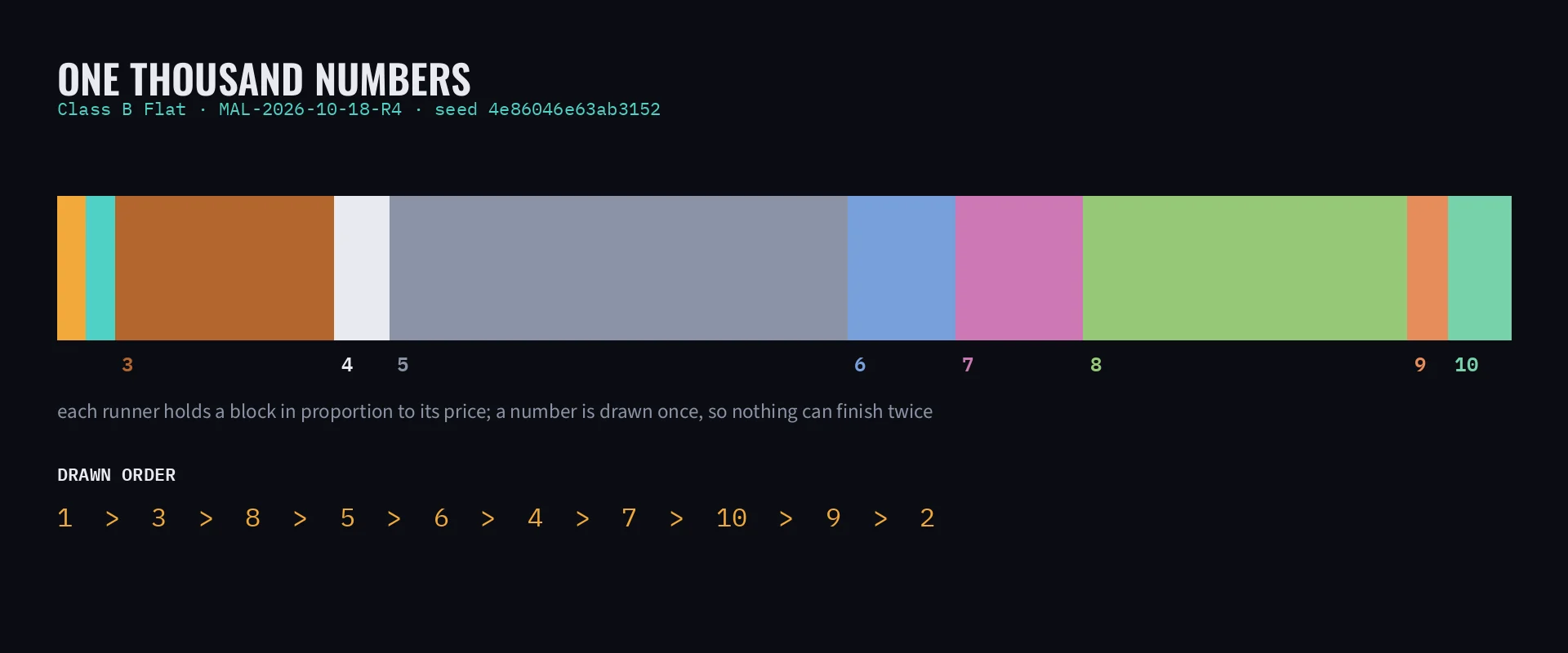
drawn order too. The Class B Flat carries seed 4e86046e63ab3152, draw
MAL-R4-4E8604, and a drawn order, by
saddlecloth, of 1 → 3 → 8 → 5 → 6 → 4 → 7 → 10 → 9 → 2.
Read that against the weighting table on the same page and the race is checkable rather than
watchable: 10 blocks,
10 draws, one order, settled at
2.43pm.
The regulated version is narrower. GLI-33 v1.1 section A.6 requires an operator to maintain all information necessary to adequately reconstruct its virtual events for the past 90 days. That is a duty to keep records, not to show them. Gallop Post meets the idea by publishing instead of archiving.
This is not a simulation of a real race
the televised one-offs
The best-known simulated horse races are not scheduled virtuals at all. The Virtual Grand National first ran in 2017 as an ITV special on the eve of the Randox Grand National, produced by Carm Productions with Inspired Entertainment and Aintree, per the Jockey Club's own page. Aintree was filmed the day after the 2016 Grand National and rebuilt in 3D, with fences that break apart when jumped (TVBEurope, 12 April 2018).
Its inputs were real. Racing Post listed age, weight, form and weather for the 2020 running, with fallers, unseated riders and collapsing fences modelled. The outcome was still randomly determined but weighted, and no edition went out live: each was pre-recorded and delivered to ITV, the result held by contractual confidentiality at the production company. The 2020 charity edition ran on ITV1 on 4 April 2020 and was won by Potters Corner at 18-1, a price Sporting Life gave as 16/1; the Betting and Gaming Council put the proceeds at over £2.9 million for NHS Charities Together. Of the editions run between 2017 and 2022, one named the eventual real winner: Tiger Roll in 2018.
The Australian instance is the Lexus Melbourne Cup "The Race of Dreams", built by Inspired Entertainment for the Victoria Racing Club with Network 10 and broadcast on Cup Day, 3 November 2020. Twenty-four past Cup champions, chosen by a panel from more than 100, ran over a 3D Flemington; Makybe Diva beat Phar Lap, with Carbine third. No bets were taken, explicitly, because the outcome was already known to the few who had made it.
That is the dividing line. A simulation of a real field makes a claim about something outside itself and can be scored against reality. A scheduled virtual race makes no such claim: there is no fact outside the draw for it to be right or wrong about.
And it is not a breeding game
the simulators
The other confusion is with a horse racing game, the commonest error in writing on this subject. Third Time Entertainment's March 2026 round-up splits the category into three product models — real-money competitive racing, casual mobile management and blockchain ownership — a vendor document about its own market, which leaves out the one that matters here: a bookmaker's animated draw is a betting product, not a game.
The games compute their races. Photo Finish LIVE grades six attributes — Start, Speed, Stamina, Finish, Heart and Temper — weighted by trip and field quality, with binary preferences for surface, direction and condition. Sheep Meadow Road Games' Horse Racing Manager inherits speed, stamina, acceleration, temperament and soundness through dominant and recessive genes. The only engine in the category with published physics is the original 2015–16 Photo Finish mobile game, written up by its developer on Game Developer on 5 May 2016: stamina is literally the rate at which speed decays after top speed. ZED RUN ran 10,000 random outcomes per race and selected one.
In all of those the attributes are causes and the race is computed. Here nothing is computed: one number is drawn and the picture follows. A Gallop Post runner has no attributes at all, only a block of numbers, and the runner profiles say so rather than dressing the block up as ability. The simulator at play shows what a weighted draw looks like on a screen, on play credits, with nothing to win and nothing to lose.
Why the weightings are printed
the paper's one claim
No commercial virtual product publishes its weighting table. The mechanic is described everywhere; the numbers themselves are printed nowhere. William Hill tells customers its virtual results are determined by an accredited random number generator and discloses a return-to-player band, but not the per-runner blocks. A Gallop Post survey of the sites ranking for virtual racing results, carried out on 18 October 2026, found no weighting table and no glossary on any of them.
So this paper prints them: numbers held, implied percentage, reference price, book, overround, seed, draw id, settle time and drawn order, on every card, upcoming and resulted, with the machine-readable file alongside. Nothing can be staked on any of it. A result nobody can check is only an animation with a caption.
Questions
8 answers
What decides a virtual race?
A weighted draw. Every runner holds a block of numbers out of 1,000 in proportion to its price, one number is drawn, and the runner holding it wins. The remaining placings are drawn from the runners still in the pool, in proportion to what they still hold. Nothing on the screen contributes to the result.
Does the animation affect the result?
No. The draw settles the finishing order before the first frame is rendered. Margins, sectionals, the mile rate and the photo finish are drawn to fit an order that already exists. A barrier holds no numbers, a livery holds no numbers and a driver holds no numbers.
Why can a race on this circuit never end in a dead heat?
A number is drawn once and the runner holding it leaves the pool, so two runners cannot share a placing and no runner can fill two. The validator rejects anything else. This is not universal across the industry: GLI-33 v1.1 still requires an operator's house rules to cover dead heats, because a product whose result is computed by a physics engine can genuinely tie.
Why do the prices on a card add up to more than 100 per cent?
Because the prices are the weighting with a margin applied. The numbers held always sum to 1,000, which is 100.0 per cent, since they are shares of one draw. The prices on the Kurrajong Mile imply 114.6 per cent, so the book carries an overround of 14.6 points — the points where a commercial margin would sit. Gallop Post holds none of it, because it takes nothing.
What is the seed for?
Reconstruction. Every card carries a 16-character seed and the full weight vector the result was drawn against, and the two together reproduce the finishing order exactly. GLI-33 v1.1 section A.6 requires an operator to maintain enough information to reconstruct its virtual events for the past 90 days. That is a duty to keep records, not a duty to show them to anyone, and no commercial virtual product publishes the numbers.
Why are there no Group races, scratchings or track ratings?
Group and Listed status is conferred by a principal racing authority and this circuit has none, so it runs six classes: Feature, Class A, Class B, Class C, Maiden and Trial. A field is generated with the card and fixed at publication, so there is nothing to withdraw. A simulated surface takes no rain and does not chop out, so there is no going and no track rating to publish.
Is this the same thing as the Virtual Grand National?
No. The Virtual Grand National and the 2020 Lexus Melbourne Cup Race of Dreams simulated real fields, so each made a claim about something outside itself and can be scored against it. A scheduled virtual race makes no such claim: there is no fact outside the draw for it to be right or wrong about.
Is this a horse racing game you play?
No. Breeding and management games compute a race from attributes a player develops over seasons. A Gallop Post runner has no attributes at all, only a block of numbers. The free simulator on this site runs on play credits and shows what a weighted draw looks like on a screen; it takes no payment, holds no account and awards no prize.
Form desk columns are editorial opinion only. They are not financial advice, not investment recommendations and not an inducement to wager. A weighted draw has no form to read in the predictive sense; what these columns argue about is the published weighting.
Gambling involves risk. If gambling is causing you harm, call Gambling Help on 1800 858 858 (free, 24/7) or visit gamblinghelponline.org.au.
Around the method
Reading a weighting table
Wren Tabakoff · 4 min
Why form cannot predict a draw
Mo Farrelly · 5 min
Three televised virtuals, and what each one proved
Gus Abernethy · 3 min