Explainer
Why form cannot predict a draw
The niche ranks tips by last month's winners while admitting the winner comes out of a generator. Both halves cannot be true. Here is which one is.
One aggregator in this niche ranks its tipsters by their wins and placings over the last thirty days. The same site tells readers that virtual winners "are chosen from a random number generator" and that the product is "more akin to lottery than to horse racing" (read 18 October 2026). Both statements sit on the same domain and nobody reconciles them. They cannot both be acted on, and this page is about which one survives.
The structure of the thing
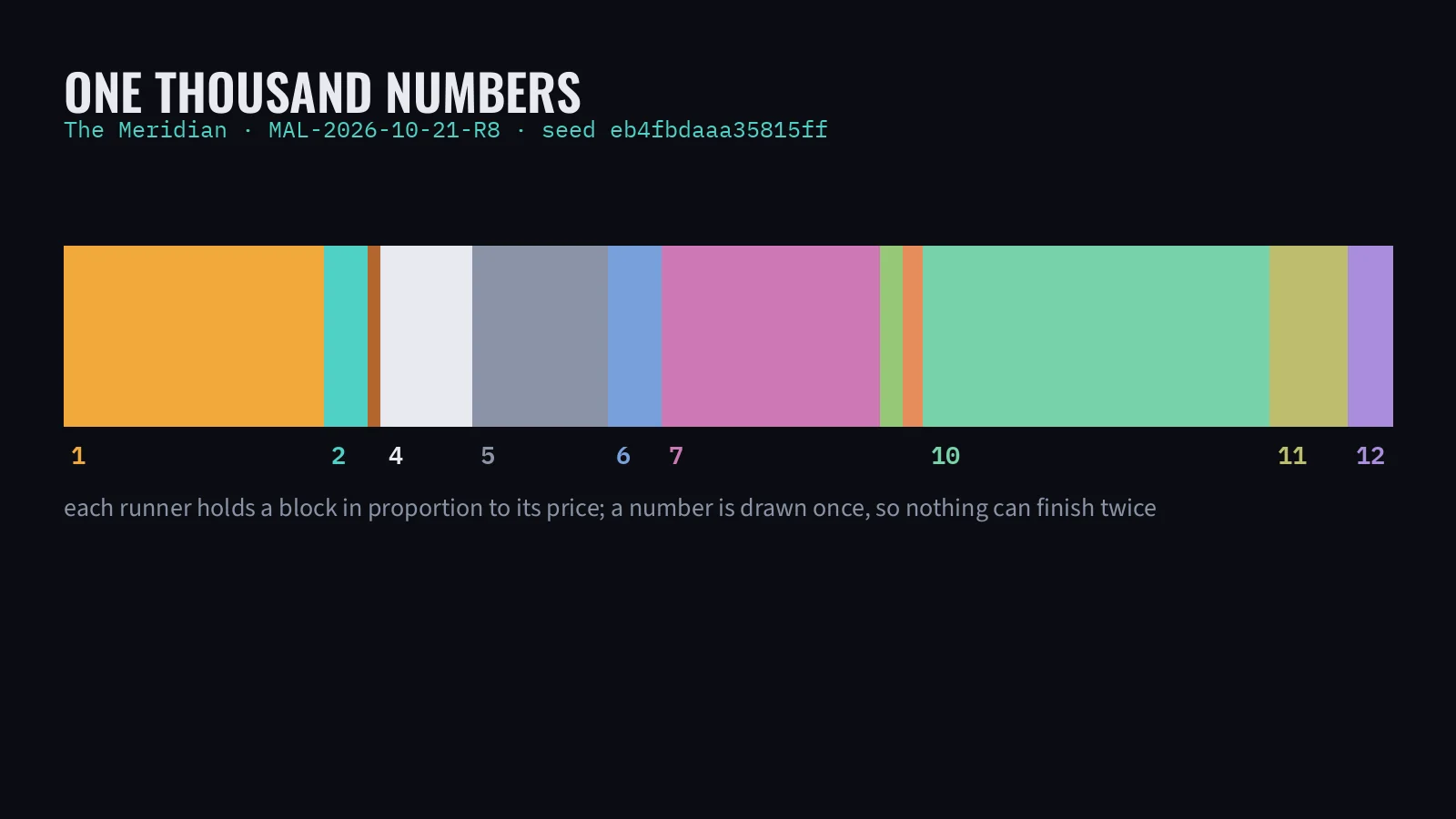
A Gallop Post race is a weighted selection of numbers from 1,000, without replacement. Each runner holds a block; its chance of winning is that block divided by ten, as a percentage. The draw is run by GP-Draw 4.2 from a published seed and nothing else goes into it.
Two properties follow, and they do all the work. First, successive draws are independent. Nothing in a card carries over from the previous one. There is no store of recent results the engine consults, which is not merely this circuit's design choice: the Gambling Commission's technical standards forbid games that adjust the chance of a win according to previous payouts or intake, and GLI-33 v1.1 §4.5 states the rule from the other side, that outcomes selected by the generator may not be modified or discarded because of adaptive behaviour (both read 18 October 2026). A compensated game is not permitted, so a draw has no memory by regulation as well as by construction.
Second, the weighting belongs to the card, not to the runner. A runner does not carry its block from race to race the way a real horse carries its rating. Each card is weighted when it is generated, and the same runner can hold a quarter of the draw on Monday and a twentieth on Tuesday.
Worked on a real runner
Stockyard Gate has four starts on the published programme and has won three of them. The numbers it held, in order:
| Race | Numbers held | Share | Price | Finish |
|---|---|---|---|---|
| Trial, Wattle Hill, 1400m (WAT-R1-DD5D9C) | 67 | 6.7% | 12.78 | 1st |
| Class A Synthetic, Tin Creek, 2000m (TIN-R8-00ABCC) | 152 | 15.2% | 5.51 | 1st |
| Class C Sprint, Saltbush Flat, 1000m (SAL-R7-EDA30F) | 21 | 2.1% | 37.67 | 10th of 12 |
| Class B Flat, Mallee Park, 1600m (MAL-R4-4E8604) | 20 | 2.0% | 40.78 | 1st |
Read the form string on its own — 4-4-1-1-0-1, career 43-9-5-3, a 20.9 per cent strike rate — and it looks like a horse in good heart. Read the weightings and the string says something else: it records that the engine gave this runner 67 numbers, then 152, then 21, then 20. The Mallee Park win came from the joint-longest price in a field of ten, 2.0 per cent of the draw, by 2.2 lengths, with Bitumen — 315 numbers, 31.5 per cent, the biggest block in the race — fourth and 7.2 lengths away. On its next card, the Jacaranda Cup, Stockyard Gate holds 136 numbers. In the Bellbird Steeple two days later it holds 24. Nothing it did in those four runs moved either figure.
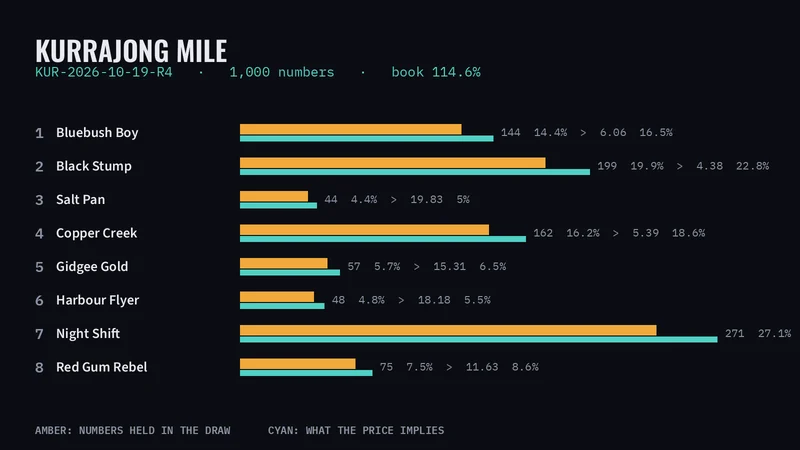
Same mechanism in the harness code. Red Gum Rebel won the Class C Mobile Pace at Kurrajong from 309 numbers, 30.9 per cent, in a mile rate of 1:53.8, holding off Gidgee Gold by a neck. On the next Kurrajong card it holds 75 numbers and is priced at 11.63. One win, and the block is a quarter of what it was.
What the aggregate says
Across the eight resulted cards on the programme, the best-weighted runner in the field won two. Add up the published weights of those eight favourites — 30.9, 31.5, 24.1, 21.0, 25.6, 27.3, 25.5 and 34.2 per cent — and the expected number of wins is 2.2. Observed two, expected 2.2, from a sample far too small to prove anything and exactly large enough to make the point: the table predicted the rate and the form guide would not have.
The two beatings worth printing. At Brolga Park over 520 metres, Brindle Jack held 241 numbers and ran last of eight, 13 lengths off Saltbush Sal, who held 65 and returned 13.44. At Tin Creek over 2000 metres, Ninepin held 273 and ran fourth. Neither is an upset in any meaningful sense. A runner with 24.1 per cent of the draw loses three times in four.
So what is form for
It is a record, and a record is worth keeping. A form string on this circuit tells you which weightings a runner has been given and what came of them, which is the only history an independent draw can have. It supports arithmetic of three kinds, all of it retrospective: whether the published weights are being honoured in the long run, whether a strike rate matches the draws behind it, and whether this desk's own columns have been right more often than the table said they would be.
What it cannot do is tell you about the next card. Not because the model is imperfect, and not because the data is thin. Because the quantity a form guide estimates — a runner's underlying ability — does not exist here. The chance is printed on the card, to one decimal place, before the race runs. There is nothing left to estimate.
Which is why the form desk says what it says at the top of every column: a weighted draw has no form, and what follows is a reading of the published weights, not a prediction of a random draw. The arithmetic is still the interesting part. It is just arithmetic about a table, and the table is on the card.
Prices on this page are the draw weighting in another notation. They are reference figures published with the card, not odds available anywhere, and not a betting recommendation.
Sources
- Gambling Commission — Remote Gambling and Software Technical Standards, RTS 7: compensated games not permitted; random numbers used in the order received read 18 Oct 2026
- Gaming Laboratories International — GLI-33 v1.1 §4.5: outcomes may not be modified or discarded due to adaptive behaviour read 18 Oct 2026
- betvirtual.co — tipster table ranked on thirty-day wins alongside the site's own statement that winners come from a random number generator read 18 Oct 2026
More from the desk
Reading a weighting table
Wren Tabakoff · 4 min

Marnie Kessel on the second line
Mo Farrelly · 3 min
A glossary for a game with no glossary
Wren Tabakoff · 4 min
Comments (3)
Comments below the first rule arrived before this page moved to the current system and are reproduced as filed.
Hollis_K
Been reading these cards for a month and the Stockyard Gate table is the first thing that made the point land. Four starts, four different blocks.
Fenner
Two from eight against 2.2 expected. Would like to see that counter kept running as the programme grows.
quietfavourite
So the form string is a receipt, not a projection. Fair enough. Still want it printed.