Culture
Eight liveries, one screen
Eight runners, one dark twilight render and three coats that are the same shade of brown. The caps are doing more work than they look like doing.
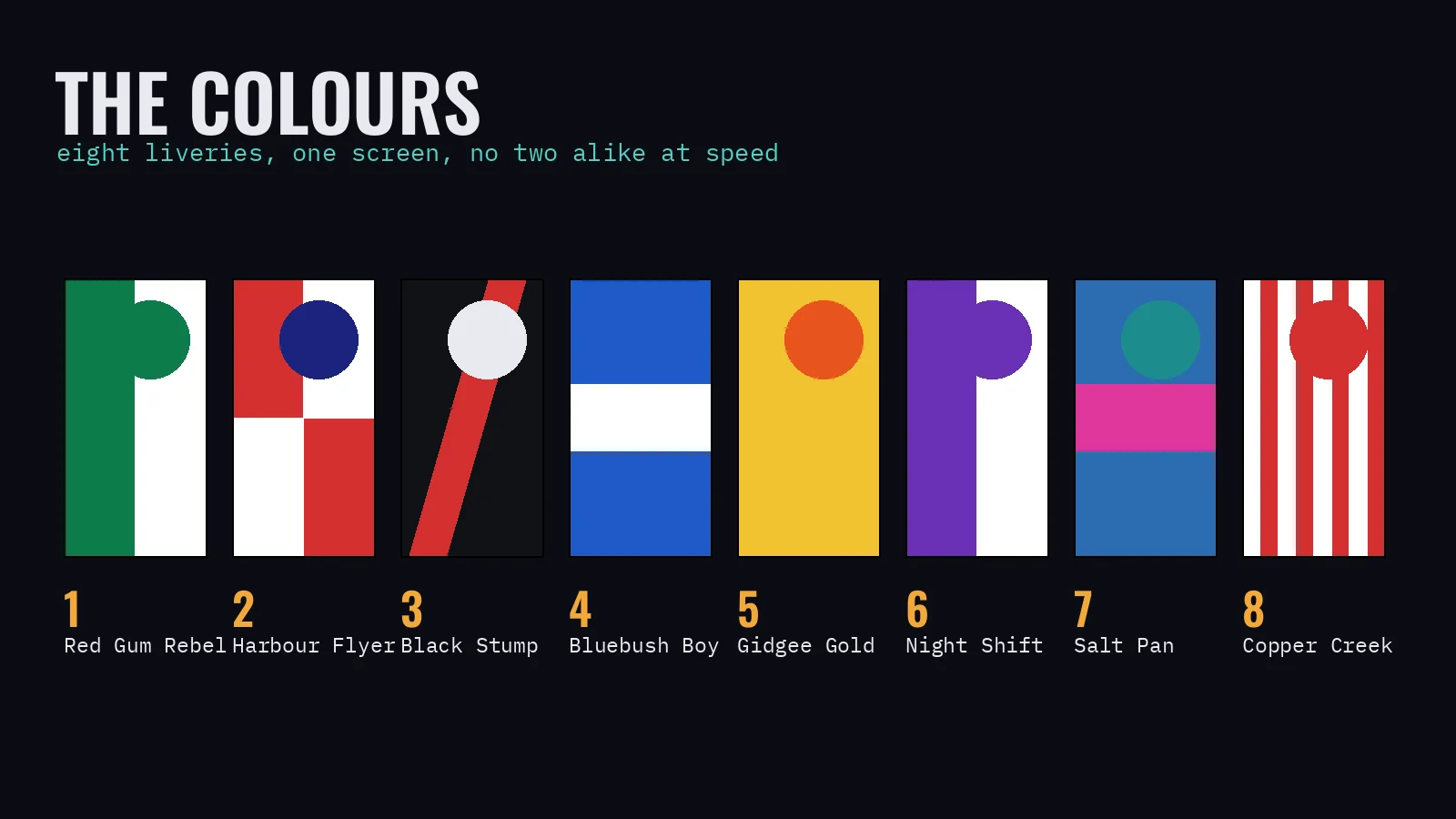
Eight pacers race at Kurrajong Paceway and the reader has to tell them apart. Not on a 600 by 400 livery card, where it is easy, but on a twilight render in which each runner is a sprite a few dozen pixels tall, side-on, in a line, moving. That is a design problem with a fixed budget, and the eight liveries are the answer to it.
| No | Runner | Coat | Livery | Sulky |
|---|---|---|---|---|
| 1 | Red Gum Rebel | Bay | Emerald and white halves, emerald cap | Blue |
| 2 | Harbour Flyer | Light bay | Red and white quarters, navy cap | Red |
| 3 | Black Stump | Dark bay | Black, red sash, chequered cap | Gold |
| 4 | Bluebush Boy | Dun | Royal blue, white band | Natural |
| 5 | Gidgee Gold | Bay | Yellow, red and orange cap | Teal |
| 6 | Night Shift | Black | Purple and white, purple cap | Magenta |
| 7 | Salt Pan | Grey | Blue, magenta pad, teal cap | Green |
| 8 | Copper Creek | Chestnut | Red and white stripes, striped cap | Gold |
The coat cannot carry it
Count the coats. Bay, light bay, dark bay, dun, black, grey, chestnut, and bay again. Five of the eight are a brown or a near-black, and three of those — numbers 1, 3 and 5 — are bays separated by nothing a reader can name at speed. The horse is the biggest block of colour on the screen and it is the least informative one. So the livery has to do the work the coat cannot, and the budget for it is the driver's torso and the cap: perhaps a dozen pixels across, lit from one side, often turned away.
Which is why no two liveries here share a pattern family. Halves, quarters, sash, band, solid with a contrast cap, two-tone, pad and stripes. Eight runners, eight geometries. A pattern survives scaling down in a way a hue does not: emerald and white halves stay halves at twelve pixels, while emerald itself turns the same muddy green as royal blue once the twilight grade is on it. Pattern is the robust channel. Colour is the pleasant one.
The caps are the index
The cap is the highest point of the sprite, clear of the sulky, clear of the rail and the only element never occluded by the horse in front. Six of the eight caps repeat the body colour, which is redundancy rather than laziness: if the torso reads, the cap confirms it, and if the torso is hidden the cap still says which runner this is. The two exceptions earn it. Black Stump's chequered cap over a black body is the one high-frequency pattern in the field, which makes number 3 findable in a blur. Copper Creek's striped cap over red and white stripes is the opposite trick, a livery legible as a whole or not at all.
Where it breaks, honestly
The sulky is the third channel and the weakest. Blue, red, gold, natural, teal, magenta, green — and gold again. Numbers 3 and 8 both run a gold sulky, and in a tight finish seen from behind that is the one genuine collision on the sheet. It survives because their liveries could not be less alike: a black body with a red sash against red and white stripes. The sulky is a confirming detail, never the identifying one, and the moment it is asked to identify a runner it fails.
The sprites map to saddlecloths in order, runner_0 through runner_7 against numbers one to eight, which means the liveries on the card, the liveries on the livery cards and the liveries in the game at play/ are one set of eight rather than three. That consistency is the whole reason for writing any of it down. It also means the demo and the cards can be read against each other, which is more than can be said for the shop product: the leading aggregator in this niche renders finishing positions as rosette graphics with no alt text, so its results are invisible both to a screen reader and to anyone trying to parse the page (checked 18 October 2026).
For comparison, the biggest game in the category hands the whole question to the player: PikPok's Rival Stars Horse Racing lets you customise jockey face, silks and helmet (press release, 18 April 2019). Eight fixed liveries is the other answer, and it is the right one for a field that has to stay recognisable across every card at four venues, every night, for as long as the circuit runs. The full set and how each one renders is on colours/.
Sources
- PikPok — Rival Stars Horse Racing: customisable jockey face, silks and helmet, 18 April 2019 read 18 Oct 2026
- Gallop Post survey of virtual racing results sites — finishing positions rendered as untagged rosette graphics read 18 Oct 2026
More from the desk
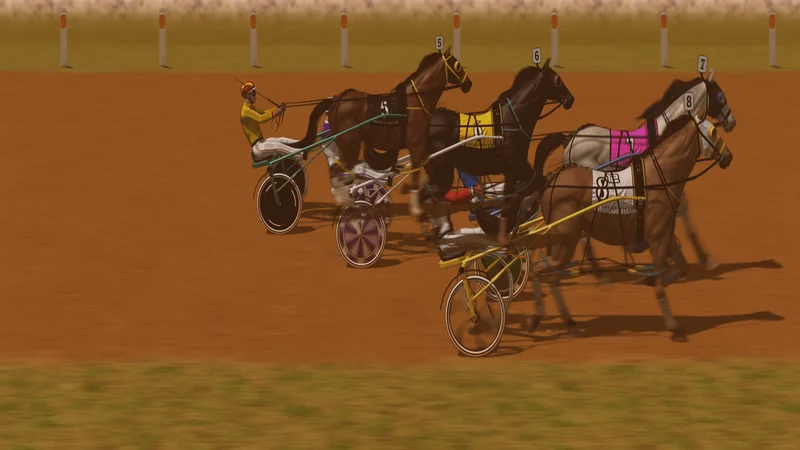
The demo opens at Kurrajong
Ilsa Brandt · 3 min
What the simulators do differently
Ilsa Brandt · 5 min
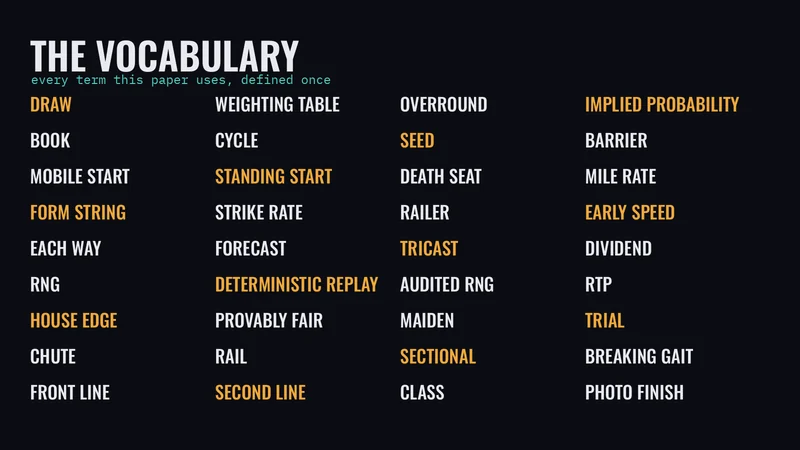
A glossary for a game with no glossary
Wren Tabakoff · 4 min
Comments (0)