Games
What the simulators do differently
Photo Finish LIVE, ZED RUN, Rival Stars and the rest resolve a race by modelling a horse. A shop-screen draw models nothing at all.
The two things called virtual horse racing are not the same thing, and the difference is not presentation. It is where the result comes from. A shop-screen race is decided by a draw and then rendered. A simulation game renders a model and reads the result off it. Four published approaches are worth separating, because copy on this subject routinely treats them as one.
Physics with modifiers
The only fully documented engine in the category is the oldest. Ian Cummings, who spent ten years at EA Sports as creative director of the Madden NFL franchise, built the original mobile Photo Finish Horse Racing in Unity over a few months in 2015 and wrote the engine up on Game Developer on 5 May 2016. Four attributes modify physics constants on a 100 to 1,000 scale: Acceleration changes the base acceleration value, Top Speed the maximum, Finish the whip input — and Stamina sets the rate at which speed decays once top speed has been reached. Fatigue in that engine is literally a decay term with a floor. The constants were tuned by eye so the best possible horse covers a quarter mile in about 20 seconds, against a real-world record the post cites at 20.57, and the slowest in about 35.
Nothing in a draw corresponds to any of that. There is no speed, no decay and no floor. There is a block of numbers.
Graded attributes and preference matching
Third Time Entertainment's current product, Photo Finish LIVE, runs six graded attributes — Start, Speed, Stamina, Finish, Heart and Temper — weighted differently by trip length and field quality, with grades expressed as letter bands from D up to SSS that are themselves ranges, so two horses on the same letter are not the same horse. Each also carries three binary preferences: surface dirt or turf, direction left or right, condition firm or soft, combined into race codes such as LDF. Churchill Downs and Third Time signed a multi-year agreement in April 2023 making it the official game of the Kentucky Derby, announced by press release on 13 April 2023. The attribute and grade detail comes from community guides and developer blog snippets rather than a primary specification, because the developer's own pages refuse automated fetching, so treat the mechanics as well-evidenced and the economics as unverified.
The direction axis is the one a reader here will recognise: left-handed and right-handed is exactly the split between Mallee Park and Jacaranda Downs. The difference is that a preference in that game changes a probability. A shape on this circuit changes nothing, because the shape is a venue parameter and the result came out of the table.
Monte-Carlo selection
ZED RUN, built by the Australian studio Virtually Human — Sydney-based according to Yahoo Finance Australia on 13 January 2022, Melbourne according to other listings, and the sources genuinely disagree — resolved a race by running 10,000 random outcomes and selecting one as the race conditions, over horses whose smart-contract traits were not fully revealed until the horse had raced. That is a subtler architecture than it sounds: the randomness picks among pre-computed outcomes rather than rolling a winner. The Polygon version shut down on 28 February 2025, reported by Decrypt on 28 April 2025; a successor, ZED Champions, relaunched on Base with 4,320 horses, and its liveness through 2026 could not be confirmed, so this desk does not assert it.
Explicit Mendelian genetics
The most explicitly documented genetics system on Steam belongs to the smallest studio. Sheep Meadow Road Games' Horse Racing Manager, in Early Access since 24 October 2025, advertises a Pseudo-DNA system passing speed, stamina, acceleration, temperament and soundness from both parents through dominant and recessive genes — its own store page puts it as breeding "where genetics actually matter" (read 18 October 2026). It grades races on the real pattern ladder, Not Graded through Listed and Group 3, 2 and 1, which this circuit deliberately does not use: Group status is conferred by a principal racing authority and a simulated circuit has none.
And the ones that just want you to ride
PikPok's Rival Stars Horse Racing, out of Wellington, has the largest audience in the category and the plainest model: breed, then train for speed, sprint energy and acceleration. It launched free on mobile worldwide on 24 April 2019 and reached consoles on 28 April 2026, with the Nintendo Switch release on 28 May 2026, priced at 29.99 in PikPok's own launch post. Strategic Designs' Starters Orders 7, from a studio founded in Manchester in 2004 by Mark Loveday, goes the other way and simulates the furniture: stewards' enquiries, non-triers, fines, handicapping, a form book with lineage readable back over a century. Its release date is a three-way argument between the developer page, which says December 2018, and Steam, which says 2 May 2019. None of these titles takes a wager.
Where the draw sits
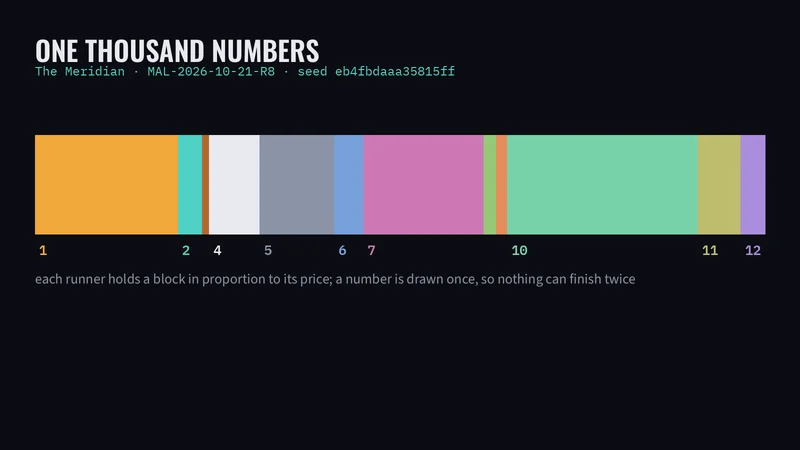
Against all of that, Wikipedia's account of the bookmaker product is flatly deflationary: a virtual race is "a visual representation of a computerised random number draw", with shorter-priced runners holding more numbers and each number drawn once (read 18 October 2026; the article is flagged as needing citations and its sourcing is thin, so it is quoted as a description rather than as an authority). Nothing is modelled. Nothing is inherited. There is no stamina to run out of.
That is not a criticism of the format, and the comparison is not a ranking. It is the reason this paper prints the weighting table instead of a form analysis. A game with genetics in it has something for form to be about. A draw has a table, and the table is public here and nowhere else.
Prices on this page are the draw weighting in another notation. They are reference figures published with the card, not odds available anywhere, and not a betting recommendation.
Sources
- Game Developer — Ian Cummings, "The making of mobile game Photo Finish Horse Racing", 5 May 2016: attributes mapped onto physics constants, stamina as speed decay read 18 Oct 2026
- PR Newswire — Third Time Entertainment and Churchill Downs multi-year agreement, 13 April 2023 read 18 Oct 2026
- Yahoo Finance Australia — ZED RUN and Virtually Human Studio, 13 January 2022: 10,000 random outcomes per race, one selected read 18 Oct 2026
- Decrypt — ZED RUN closed 28 February 2025 and reborn on Base with 4,320 horses, 28 April 2025 read 18 Oct 2026
- Steam — Horse Racing Manager (Sheep Meadow Road Games): Pseudo-DNA, dominant and recessive genes, Early Access 24 October 2025 read 18 Oct 2026
- PikPok — Rival Stars Horse Racing mobile launch, 18 April 2019 read 18 Oct 2026
- Rival Stars Horse Racing — console launch post, 28 April 2026 read 18 Oct 2026
- Strategic Designs Ltd — studio and catalogue, founded Manchester 2004 by Mark Loveday read 18 Oct 2026
- Steam — Starters Orders 7 feature list and 2 May 2019 release date read 18 Oct 2026
- Wikipedia — Virtual racing: "a visual representation of a computerised random number draw" (article flagged as needing citations) read 18 Oct 2026
More from the desk
Why form cannot predict a draw
Mo Farrelly · 5 min
The demo opens at Kurrajong
Ilsa Brandt · 3 min
A glossary for a game with no glossary
Wren Tabakoff · 4 min
Comments (0)