Industry
Trackside: an Australian circuit documented by its own patent
A Keno-style draw picks an index number, the index points at a finishing order, and the animation is made afterwards.

Australia has had its own licensed simulated racing circuit for most of two decades, and the clearest account of how it works is a patent almost nobody reads.
Trackside runs under Tabcorp's wagering licences. The Totalizator Amendment Act 2010 (NSW) No 94 amended the Totalizator Act 1997 so that a betting activity on computer simulated horse, harness or greyhound racing could be approved, and the explanatory note names the game. Section 15AA of the 1997 Act gives that approval exclusively to TAB Limited, for a period running to 2097. The Betting Tax Act 2001 (NSW) treats it as a product class of its own: no betting tax on the first $255 million of computer simulated racing bets in a financial year, a threshold that ceases at the end of 30 June 2034. A Tabcorp submission to the House inquiry into online gambling describes Trackside as an animated racing game authorised under wagering licences in New South Wales, Victoria and the ACT.
Victoria licenses it expressly. The VGCCC records the wagering and betting licence held by Tabcorp Wagering (VIC) Pty Ltd, granted in December 2023 for twenty years and effective from August 2024, and notes that the licensee also offers approved simulated racing games. Western Australia is the outlier: ABC News reported on 11 July 2018 that only Crown Casino could offer simulated racing products there, and the then acting Liberal leader Liza Harvey called the product "pokies by stealth".
The mechanism is in WO2005102477A1, "Method of generating a result of a racing game", applicant Tabcorp International Pty Ltd, inventors Clyde Wilson Torkington and Howard Silver, Australian priority filed 27 April 2004 and published 3 November 2005. Every possible finishing order is mapped to an index number. Ranges of index numbers are assigned to those finishing orders. A Keno-style draw — the worked example is twenty numbers from eighty, with the first four taken in draw order — selects the index, and the finishing order it points at becomes the result. The preferred embodiment uses twelve participants, which gives 1,320 trifecta permutations, and states that a result comprises the first three.
Two lines in it are worth any amount of marketing copy. The win odds are nominated by the game operator, with place, quinella and trifecta odds derived by published algorithms on an assumed house return of 20 per cent — a 125 per cent market. And the host computer determines the result first, then instructs the graphics engine to create the race simulation.
The animation is a dramatisation of a decision already made. That is not a criticism of the product. It is the product.
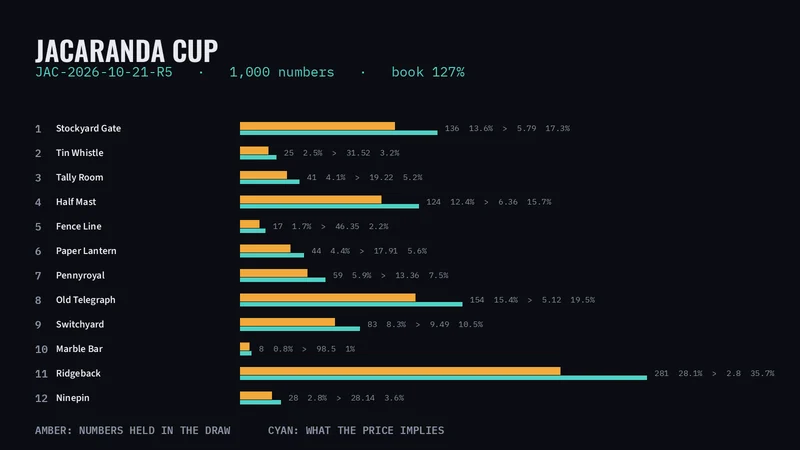
For comparison, the book on this circuit's Jacaranda Cup is 127.0 per cent across twelve runners, and the Class B Sprint at Brolga Park settled on 114.4 across eight. The patent's 125 is in the same country as our figures. The difference is that ours are printed on the card, runner by runner, beside the weighting table the result was drawn from.
What cannot be checked is the product as it runs now. The site tabtrackside.com.au refuses requests from outside Australia: on 18 October 2026 a direct fetch returned HTTP 503 from an Akamai edge host named geoblock-tabtrackside.com.au. Its results and learn-to-play pages are unreadable from here, so this desk has no current field sizes, race frequency or runner names for Trackside, and will not guess at them.
Sources
- Totalizator Amendment Act 2010 (NSW) No 94 read 18 Oct 2026
- Totalizator Act 1997 (NSW), s 15AA read 18 Oct 2026
- Betting Tax Act 2001 (NSW) read 18 Oct 2026
- WO2005102477A1, "Method of generating a result of a racing game", Tabcorp International Pty Ltd read 18 Oct 2026
- VGCCC, wagering and betting licence read 18 Oct 2026
- ABC News, "Virtual horse race gambling considered for WA in TAB sale", 11 July 2018 read 18 Oct 2026
- TAB help centre, Trackside information and results read 18 Oct 2026
More from the desk
Three televised virtuals, and what each one proved
Gus Abernethy · 3 min
The Jacaranda Cup weighting looks wrong. It is not.
Wren Tabakoff · 3 min
A glossary for a game with no glossary
Wren Tabakoff · 4 min
Comments (0)