Analysis
The terminal era and the missing record
The statutes are on the record and dated. The claim that animated racing was a significant product on those screens is not, and this column will not print it as though it were.

There is a story the category tells about itself in which animated horse racing swept through betting shops and lottery halls across two continents in the 2000s. Half of that story is documented. The other half is an assertion repeated by equipment vendors, and this column is going to say which half is which.
The shop, which is partly documented
An undated ESPN column reports Portman Park virtual racing handling 2.8 million pounds a week, with single bets of up to 25,000 pounds on a race, describes the tracks as "a cooperative venture among leading UK bookmakers", and gives part of the rationale as filling the voids when real racing was abandoned for weather (read 18 October 2026). The same column carries the only Racing Post voice on the subject this desk could find anywhere, and it is Paul Haigh calling the product "this abomination", "a computerised 'race' on which betting is supposedly conducted" and "plain and simple trash".
The quotes are usable. The figure is not datable. The column carries no year, and context only places it in the early 2000s, so 2.8 million pounds a week is a number without a denominator. This desk prints it as a quotation from an undated source and not as a measurement.
What is datable is thin and bracketed at both ends. The Guardian's 2007 report of 17 per cent of UK horse-racing bets and over 700 million pounds a year is the high reading. The Gambling Commission's online series to March 2025, running at roughly three million pounds of gross gambling yield a month against roughly 200 million for real events, is the low one, and the Commission does not report retail virtual betting at all. The Commission's wider figures for 2025 to 2026 give 5,617 betting shops in Great Britain, down 3.6 per cent, and Racing Post reports over-the-counter horseracing turnover in those shops falling 3.65 per cent to 2.9 billion pounds in the year to March 2026 (all read 18 October 2026). The estate the product was built for is shrinking, which is a fact about shops rather than about draws.
The hall, which is not
Now the part that does not hold up. The word usually used for the post-Soviet terminal hall is colloquial and has no definition in any source this desk searched. The statutory term in Russian law is the lottery terminal, defined in the Lottery Law as a technical device for accepting lottery bets — entering or selecting lottery combinations — and issuing lottery receipts, used in draw-based lotteries (read 18 October 2026).
The legal skeleton around it is solid and dated:
| Instrument | Date | Effect |
|---|---|---|
| Russia, Federal Law 244-FZ | in force 1 July 2009 | Gambling confined to four designated zones; lotteries and totalisators expressly carved out |
| Ukraine, Law No. 5204-VI | 6 September 2012 | Lotteries permitted through terminals of the electronic bet-acceptance system; such terminals may not themselves determine the draw result |
| Russia, Federal Law 416-FZ | in force 30 January 2014 | Permits ceased from 30 December 2013; instant-ticket distribution via internet, communications and lottery terminals prohibited; gambling disguised as lotteries prohibited |
| Russia, Federal Law 222-FZ | in force 21 July 2014 | Full ban on internet casinos and online gambling |
The carve-out in the 2009 law is the whole reason the hall existed: when every other form of gambling was confined to four zones and lotteries were not, the lottery terminal became the vehicle for slot-style play. The Ukrainian provision is the most useful single line in the whole file, and it cuts the other way — a terminal that decides its own draw result would not comply, so a race generated inside the box in the corner of the room was not a lawful product there.
The unwinding is on the record too, in outline. Ukrainian lottery operators' licences expired in March 2014 with no renewal procedure in place; the Interior Minister declared war on slot halls posing as lotteries in December 2014; a draft law of 24 July 2015 proposed a state monopoly and restrictions on where terminals could stand, and this desk could not confirm whether it was enacted. Lottery receipts to the Ukrainian budget fell from 318.9 million hryvnia in 2014 to 26.5 million in 2015 (all read 18 October 2026, Ukrainian press only). The Ukrainian National Lottery has operated since 1997 with reportedly more than 5,200 terminals installed nationally.
The one software trail
There is exactly one supplier trail and it points at the present, not the past. Inbet Games gives 2002 as its founding year on its own Russian-language site and says its first product that year was software for television lotteries; an English-language directory instead gives 2001 in Moscow. Its own timeline runs self-service lottery machines from 2008 and the Lima platform from 2012, with more than 11,000 devices connected across about ten countries in that platform's first year. Its in-hall screen product lists virtual sports including horse racing and dog racing, and it sells a terminal software-and-hardware package (read 18 October 2026, the About page through search indexing because it refuses direct fetching).
Read that carefully. The virtual racing page is current. It is not evidence of anything in 2006. No source this desk found shows virtual horse or greyhound racing running on Russian or Ukrainian lottery terminals at any point between 2000 and 2013. The product category those statutes and those prosecutions describe is slot-style instant-lottery play. Affiliate pages and equipment-vendor pages that say otherwise are marketing, and this desk declines to launder them into history.
Where the lottery channel is documented
If the subject is virtual racing inside a lottery network, the evidence is in western Europe and North America and it is good. Italy regulates virtual betting as its own product category with its own tax tables, set by decree on 2 December 2011, and its customs and monopolies agency has published an annual virtual-betting data file for every year from 2014 to 2026 (read 18 October 2026). That is the best public time series in existence on regulated virtual betting, and it will not answer the question this piece is about, because the page carries no breakdown by event type: virtual football and virtual racing are one line. One monthly indicator gives Italian virtual-betting stakes of about 391.9 million euros in September 2024, up 9.26 per cent year on year (read 18 October 2026).
Greece's state operator runs Inspired virtuals over the counter in more than 4,000 venues and on self-service terminals; Finland's state monopoly went live with the same supplier; the Pennsylvania Lottery became the first major US lottery to launch Inspired virtual sports in 2018, and the Virginia Lottery added virtual sports iLottery games in 2025 (all read 18 October 2026). Terminals and racing screens genuinely met in those places, on the record, with dates.
What this desk will not print
Three claims in current circulation, and why each one stays out:
- A reported Russian prohibition on bookmakers using programs that imitate slot machines, where the result is predetermined by a mathematical algorithm. It would be directly relevant to a draw-based race. It appears only on low-quality pages, with no statutory citation and no established date, so it is not stated here as law.
- Highlight Games as a current virtual racing supplier. It announced in February 2022 that it would add virtual horses and dogs, with content from a company credited with having helped build the very first UK virtual horse and dog racing products. Its own site in October 2026 lists football, motorcycling, tennis, ice hockey, darts, instants and slots, and no racing product at all (verified 18 October 2026). Either the plan did not ship or it has been withdrawn.
- BetGames as a racing supplier. No horse or greyhound product was found on its own site or anywhere else, and its founding year is 2012 in Vilnius according to directory sources, not the 2008 that circulates (read 18 October 2026).
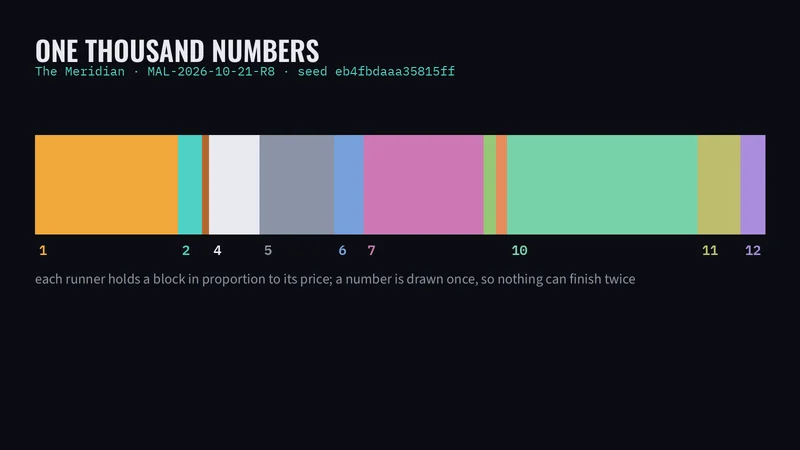
None of this is a complaint about the subject. People played these screens for a quarter of a century and the legal history around them is genuinely interesting. The complaint is about the writing, which has filled the documentary hole with vendor copy for years. A circuit that prints its own weighting table, its seed and its cadence — Tin Creek runs 297 races in 24 hours, Saltbush Flat 240 between 9am and 5pm — has no business being vague about anybody else's.
Prices on this page are the draw weighting in another notation. They are reference figures published with the card, not odds available anywhere, and not a betting recommendation.
Sources
- ESPN (undated column) — Portman Park at 2.8 million pounds a week, single bets to 25,000 pounds, "a cooperative venture among leading UK bookmakers"; Paul Haigh quoted read 18 Oct 2026
- Russian Lottery Law, article 6.1 as published — definition of a lottery terminal read 18 Oct 2026
- Law of Ukraine No. 5204-VI of 6 September 2012, On State Lotteries in Ukraine — terminals of the electronic bet-acceptance system may not determine the draw result read 18 Oct 2026
- Russian Federal Law No. 416-FZ of 28 December 2013, in force 30 January 2014 — amendments to the Lottery Law read 18 Oct 2026
- Inbet Games — current product range including an in-hall virtual sports screen product listing horse and dog racing; About page via search indexing (403 on direct fetch) read 18 Oct 2026
- Agenzia delle Dogane e dei Monopoli — Scommesse Virtuali annual data files, 2014 to 2026, with no breakdown by event type read 18 Oct 2026
- UK Gambling Commission — industry statistics for 2025 to 2026: 5,617 betting shops, down 3.6 per cent read 18 Oct 2026
- Highlight Games — own site product list in October 2026 contains no horse or greyhound racing product (verified directly) read 18 Oct 2026
- BetGames — own corporate and product pages; no racing product, Lithuanian registration no. 302708264 read 18 Oct 2026
More from the desk

Twenty-five years of the screen wall
Gus Abernethy · 7 min
The Australian frame for a simulated race
Gus Abernethy · 8 min
What a virtual product would have to publish
Wren Tabakoff · 7 min
Comments (2)
Comments below the first rule arrived before this page moved to the current system and are reproduced as filed.
V_Horlova
The line about a terminal not being allowed to decide its own result is the part everybody writing about those halls has missed.
Dobbo
Refreshing to read a piece that stops where the sources stop.