Opinion
What a virtual product would have to publish
The rules already require an operator to be able to rebuild a virtual race. They do not require anyone to show it. Eight items would close that gap, and this paper publishes seven of them.
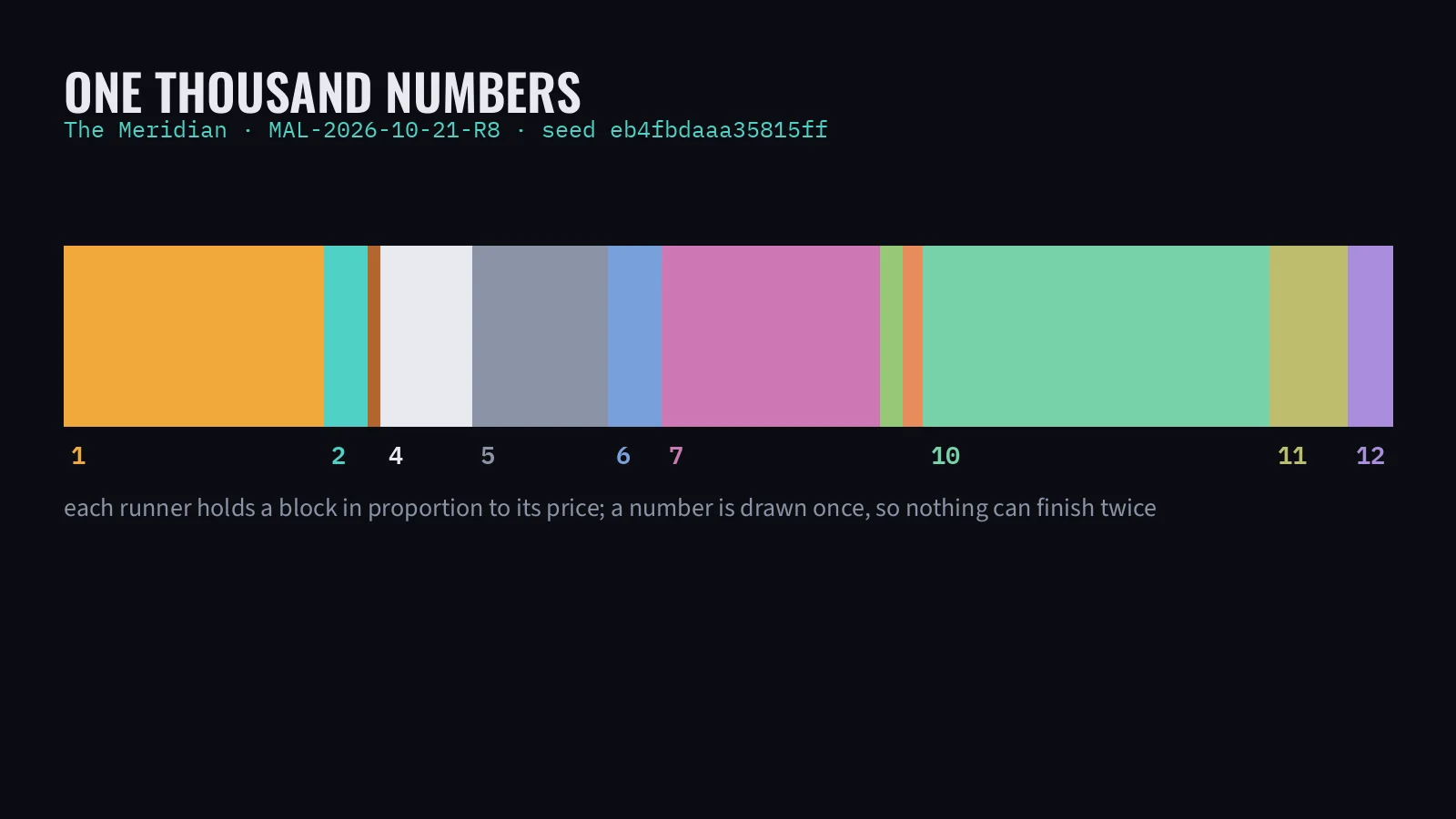
A virtual race is the most reconstructable sporting event ever devised. There is no weather to argue about, no camera angle to dispute and no horse with an opinion. There is a table of numbers, a generator and a result. And almost none of it is published, by anybody, anywhere.
This column has a position and states it: a product whose results cannot be checked by the people reading them is a worse product than one whose results can, and the cost of closing that gap is close to nothing. Here is the list.
Eight items
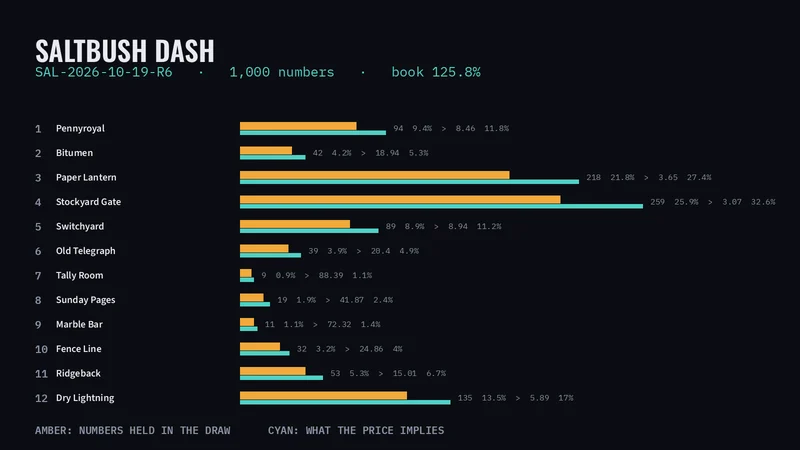
- The weighting table. Numbers held per runner, and the true probability that implies. Without it the price is an assertion.
- The book total. One figure per race. It is the difference between the two percentage columns and it belongs on the card, not in a help centre.
- The seed and the engine version. The starting value that fixed the sequence, and which build produced it.
- The settle time. When the result became official, to the minute.
- The full finishing order. Every runner, not the first three or four.
- Margins and times. Whatever the renderer produced, in the units it produced them in.
- A permanent archive with one permalink per race. Not a date picker covering two years.
- Machine-readable data. The same rows the page renders, as a file.
What is published instead
Start with the one that holds the data. The authoritative British archive is served through a client-side application: fetch any racecard or results page and the readable text is the brand name and an instruction to enable JavaScript, while the data host returns a 403 to an unauthenticated request for the latest results (verified 18 October 2026). The 2023 supplier release promises that all historical results and form will be available there. They may well be. Nobody outside can cite one.
The aggregators that exist to work around that failure drop more than they carry. The best-built of them renders finishing positions as rosette images with no alt text, so a result is invisible to a screen reader and to anything parsing the page; carries a Stats column that is empty on every row across three track pages; lists only the first three or four finishers without saying whether that is the field; and offers a results date picker covering 2025 and 2026 (all verified 18 October 2026). To its credit it also says, under its own heading, that virtual racing is "more akin to lottery than to horse racing" and that winners "are chosen from a random number generator", which is more honesty than the suppliers manage.
One competitor describes itself as "the premier independent authority and real-time data platform for virtual horse racing across the United Kingdom" and promises "instant finishing orders, starting prices (SP), winning margins, jockey statistics, and detailed race cards". Three of its pages were fetched on 18 October 2026 and contained no results table, no race times, no runners, no odds and no horse names. Its editorial policy claims all racing data is "verified against official RNG feeds" and that its tips are "generated by objective statistical models", under no named author and with no corrections policy. A fourth site in the same niche now returns an HTTP 500, and when it was alive its results pages said "Currently unavailable" and were cleared at midnight each day by design.
Meanwhile the richest racecard markup in the category belongs, almost by accident, to a retail bookmaker publishing a full day of cards as plain server-rendered HTML — 179 race blocks on one page, each runner carrying a horse name, a rider name and a price, with the rider names truncated at thirteen characters (parsed 18 October 2026). The feed carries named riders. No aggregator surfaces them. Data is being amputated on the way through, and nobody is deciding to do it; it is just nobody's job to carry it.
The suppliers publish least of all. Inspired's V-Play Horses page gives three race types, their durations and the camera angles, and states no return to player, no margin, no generator and no certification. GoldenRace's horse racing page has an RNG badge among fifteen footer logos and no generator statement in the text. This desk found no return-to-player figure published for any current British virtual racing product, and no certification document on any laboratory's site for any of them. The firmest public margin figure in the category remains a 2005 Australian patent's worked assumption of a 20 per cent house return.
The duty already exists
This is the part of the argument that matters, because it means nothing new has to be invented.
Gaming Laboratories International's event wagering standard already requires an operator to "maintain all information necessary to adequately reconstruct the virtual events, including the virtual event outcome and/or virtual participant actions, conducted within the past 90 days", by "some combination of text, logs, video, graphics, screen captures, or other means (e.g., 'flight recorder' mechanism)" (GLI-33 v1.1, revision date 14 May 2019, read 18 October 2026). The same standard requires that it "shall not be possible to ascertain the outcome of the virtual event prior to its commencement", forbids modifying or discarding outcomes because of adaptive behaviour, and provides that statistical data made available to the player "shall not misrepresent the capabilities of any virtual participant".
In Britain, the Gambling Commission's standard on random outcomes applies expressly to betting on virtual events: outcomes must be acceptably random and demonstrable by generally accepted statistical tests, compensated games are not permitted, random numbers must be used in the order received, and probabilities may not change while a game is available for gambling except as the rules provide — with the guidance naming "virtual racing odds that vary by event based on the runners" as a legitimate variation (read 18 October 2026).
So the reconstruction already happens. The weights are already fixed per race, written down and defensible. The seeds already exist. What is missing is not capability or data. It is an audience: the duty runs to a regulator, privately, for ninety days, and to nobody else ever.
And the mechanism for showing it has already been built in an adjacent category. A provably fair scheme publishes a hash of the operator's server seed before play, mixes in a value the player contributes and a per-round counter, and reveals the seed afterwards so the player can recompute the outcome. Nothing in GLI-33 or in the British standard prohibits a virtual racing feed from committing to a seed hash before the betting window and revealing it after the settle. Nobody does it. There is no technical reason, and the commercial reason is not one anybody has put in writing.
What this paper publishes, and what it does not
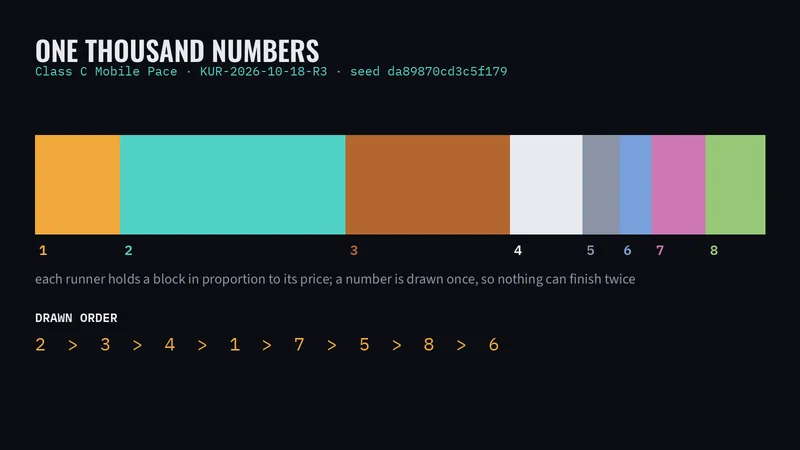
Seven of the eight. Every card on this circuit carries the engine build, GP-Draw 4.2, a draw id, the full weighting table, the implied percentage per runner, the book total, the settle time and a sixteen-character seed unique across the site. Resulted cards print every runner's finishing position, the margins, the time, the reference dividends and the raw draw order the result came out of. The Kurrajong Mile is draw id KUR-R4-9FDFCB, seed 9fdfcb9f663c7980, book 114.6, and the Class B Mobile Pace forty minutes later on the same programme is a different seed and a book of 115.8. The whole lot downloads as CSV and JSON.
That is enough to check several things a reader could not check anywhere else. The Jacaranda Cup book of 127.0 is the largest on the programme and the Class B Sprint at Brolga Park at 114.4 is the smallest, and both figures can be verified by adding up a column. Stockyard Gate winning the Class B Flat from 20 numbers of 1,000 is checkable against the table it was drawn from, which is the only sense in which it can be checked at all.
The eighth item is the one this paper does not yet have, and the column will not pretend otherwise. A seed and a weight vector are not a reconstruction unless the method that turns the one into the other is published and versioned. At present a reader can verify that the prices match the weights and that the weights sum to 1,000. A reader cannot take seed 9fdfcb9f663c7980, run it, and get the same eight finishers back. That is a real gap, it is this desk's gap, and the position of this column is that it should be the next thing published. Until it is, the honest description of what is on the site is a published table and a published seed, not a reproducible draw.
Nothing is staked here, so none of this protects anybody's money. That is rather the point. If a free paper with no revenue at risk can print the whole of a race, the case for a commercial product printing most of it is not a technical argument, and it has never been made in public.
Sources
- GLI-33 Event Wagering Systems v1.1, 14 May 2019 — section A.6 reconstruction duty for 90 days; section 4.5 outcome and statistical-data requirements read 18 Oct 2026
- UK Gambling Commission — RTS 7, generation of random outcomes, applying to betting on virtual events; compensated games not permitted read 18 Oct 2026
- UK Gambling Commission — definition of terms: a compensated game adjusts the likelihood of winning outcomes based on previous payouts or intake read 18 Oct 2026
- 49s.co.uk — racecard and results pages return a JavaScript shell; api.49s.co.uk returns 403 unauthenticated (verified by direct request) read 18 Oct 2026
- betvirtual.co — results pages: positions rendered as rosette images without alt text, empty Stats column, first three or four finishers only; its own statement that virtual racing is "more akin to lottery than to horse racing" read 18 Oct 2026
- portmanparkresults.com — self-description and promised data fields; three pages fetched contained no race data read 18 Oct 2026
- A. McLean Bookmakers — a full day of virtual cards as server-rendered HTML, 179 race blocks, horse and rider names with prices, rider names truncated at 13 characters read 18 Oct 2026
- Inspired Entertainment — V-Play Horses: three race types and camera angles, no RTP, margin, RNG or certification stated read 18 Oct 2026
- WO2005102477A1 — Tabcorp International Pty Ltd: worked example assuming a 20 per cent house return, a 125 per cent market read 18 Oct 2026
More from the desk
The cost of the book
Mo Farrelly · 6 min
The first published window
Wren Tabakoff · 8 min

Twenty-five years of the screen wall
Gus Abernethy · 7 min
Comments (3)
Comments below the first rule arrived before this page moved to the current system and are reproduced as filed.
K_Nguyen
The ninety-day reconstruction duty running to a regulator and nobody else is the whole argument in one sentence.
Ange_M
Publish the generator. Half the readers here would run it the same afternoon.
leftHandTurn
Marking your own missing eighth item is more convincing than the other seven put together.