Analysis
The cost of the book
Twelve runners, 1,000 numbers and a book of 127.0. The margin is 27 points and the shortest price in the field is carrying 7.6 of them.
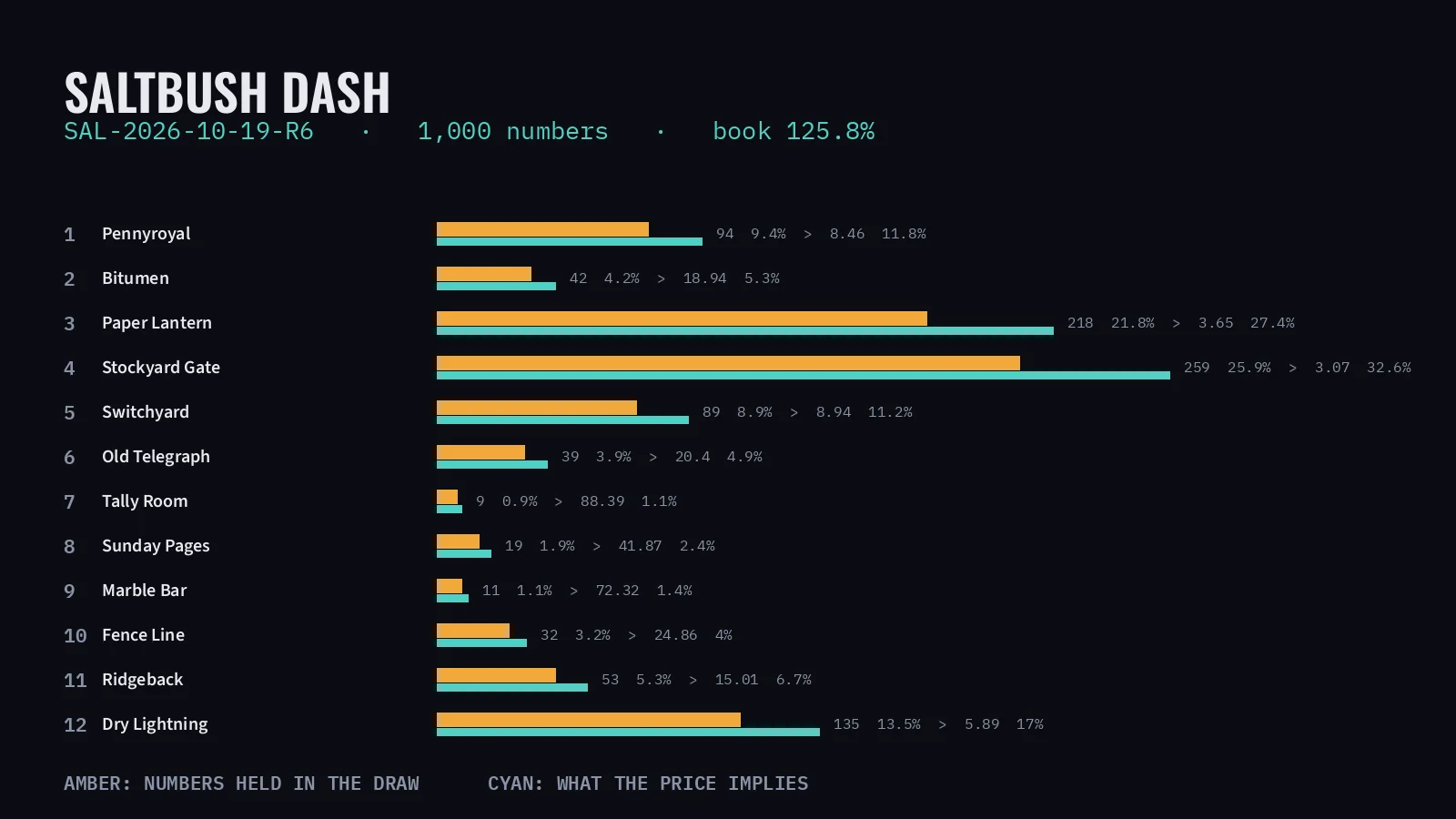
This column cannot help anyone beat a draw and says so before it starts. A Gallop Post race is a weighted draw of 1,000 numbers without replacement, so the only thing that decides it is how many numbers a runner holds. What follows is arithmetic on a published table, not a forecast of anything.
The arithmetic is worth printing because the table is printed. Every card on this circuit carries the weighting table the result came from, the implied probability of every price, and the book total. Two percentage columns sit side by side on each card and they do not agree. The distance between them is the margin, and on the biggest book on this circuit it comes to 27 points.
The card
The Jacaranda Cup is twelve runners over 2400 metres at Jacaranda Downs, draw id JAC-R5-4D9D09, book 127.0. That is the largest book on the published programme of 21 cards. Sorted by numbers held, with two columns the trade does not print:
| No | Runner | Numbers held | True | Price | Implied | Margin | Level price |
|---|---|---|---|---|---|---|---|
| 11 | Ridgeback | 281 | 28.1% | 2.80 | 35.7% | 7.6 pts | 3.56 |
| 8 | Old Telegraph | 154 | 15.4% | 5.12 | 19.5% | 4.1 pts | 6.49 |
| 1 | Stockyard Gate | 136 | 13.6% | 5.79 | 17.3% | 3.7 pts | 7.35 |
| 4 | Half Mast | 124 | 12.4% | 6.36 | 15.7% | 3.3 pts | 8.06 |
| 9 | Switchyard | 83 | 8.3% | 9.49 | 10.5% | 2.2 pts | 12.05 |
| 7 | Pennyroyal | 59 | 5.9% | 13.36 | 7.5% | 1.6 pts | 16.95 |
| 6 | Paper Lantern | 44 | 4.4% | 17.91 | 5.6% | 1.2 pts | 22.73 |
| 3 | Tally Room | 41 | 4.1% | 19.22 | 5.2% | 1.1 pts | 24.39 |
| 12 | Ninepin | 28 | 2.8% | 28.14 | 3.6% | 0.8 pts | 35.71 |
| 2 | Tin Whistle | 25 | 2.5% | 31.52 | 3.2% | 0.7 pts | 40.00 |
| 5 | Fence Line | 17 | 1.7% | 46.35 | 2.2% | 0.5 pts | 58.82 |
| 10 | Marble Bar | 8 | 0.8% | 98.50 | 1.0% | 0.2 pts | 125.00 |
| Field | 1,000 | 100.0% | 127.0% | 27.0 pts |
Three sums and the card is reproduced
Divide the numbers held by ten and you have the true probability, because the blocks sum to exactly 1,000. Ridgeback holds 281, which is 28.1 per cent. Marble Bar holds 8, which is 0.8 per cent and the smallest block anywhere on the programme.
Multiply the true probability by the book, as a factor of 1.27, and you have the implied percentage. Ridgeback moves from 28.1 to 35.7. Marble Bar moves from 0.8 to 1.0. Invert that and you have the price: 100 divided by 35.7 is 2.80, which is what the card prints.
In one line, for any runner on any card on this circuit: price = 100,000 divided by (numbers held multiplied by the book). On the Jacaranda Cup that reproduces all twelve published prices to within a tenth of a per cent, the residue being rounding in the percentage column rather than anything happening behind it.
The level-price column
The last column is the price that would return exactly a runner's share of the draw: 1,000 divided by numbers held, with no book at all. Ridgeback's 281 numbers are worth 3.56 against the 2.80 printed. Marble Bar's 8 are worth 125.00 against 98.50. The two columns together are the only honest way to read a virtual price, and this is the only paper that prints both.
Because the shading is one flat multiplier, the margin is proportional to the share. Take 27 per cent of the true column and the margin column falls out: 28.1 becomes 7.6 points, 0.8 becomes 0.2. The shortest price in the field carries 38 times the margin of the longest, measured in points, while the longest price carries the largest proportional reduction in nothing at all — the proportion is identical for every runner, which is exactly the point people miss when they look for a mispriced outsider on a card like this one.
What field size does
Field size sets the book and almost nothing else does. Across the 21 cards on the programme:
| Field | Cards | Mean book | Per runner |
|---|---|---|---|
| 8 runners | 10 | 116.22 | 2.03 pts |
| 10 runners | 7 | 120.50 | 2.05 pts |
| 12 runners | 4 | 125.88 | 2.16 pts |
The smallest book on the circuit is 114.4, on the Class B Sprint over 520 metres at Brolga Park, which works out at 1.80 points a runner. The largest is the 127.0 above, at 2.25. The trade rule of thumb — about 2 per cent a runner, given in Wikipedia's article on virtual racing and flagged on that page as needing a citation (read 18 October 2026) — holds across this circuit to within two tenths of a point. Eight runners buy a tighter book than twelve, every time, for arithmetic reasons and no others.
The number the trade does not print
Commercial virtual racing publishes almost none of this. Inspired Entertainment's own V-Play Horses product page describes the three race types and the camera angles and states no return to player, no margin, no generator and no certification (read 18 October 2026). GoldenRace's horse racing page carries an unexplained RNG badge among its footer logos and makes no generator statement in the page text (read 18 October 2026).
The firmest figures in public are a return-to-player table on William Hill's virtual help page, which gives 89.29, 87.71 and 82.64 per cent for win and each-way racing markets against field sizes of 8, 10 and 16, and 90.91 per cent for sprints and jumps (read 18 October 2026 through search indexing, because the page refuses direct fetching). Return to player is the reciprocal of the book, so those four figures are books of about 112, 114, 121 and exactly 110. The Jacaranda Cup's 127.0 is dearer than any of them, and it is dear because twelve runners is a wide field.
The oldest hard number of the lot is Australian. Tabcorp's 2005 patent application for the method behind Trackside sets out a worked example assuming a house return of 20 per cent — a 125 per cent betting market — with payouts rounded to 5-cent denominations (WO2005102477A1, published 3 November 2005, read 18 October 2026). Whether any live product has ever run at that figure is not established anywhere this desk could find.
Gallop Post holds none of the 27 points. Nothing is staked on this circuit, no account exists and no bet can be placed, so the book is a published parameter of the draw rather than anyone's revenue. That is the only reason it can be printed in full.
One more use for the table
A draw without replacement gives any exact finishing order a computable chance. Ridgeback then Old Telegraph: 28.1 per cent for the first leg, then Old Telegraph's 154 numbers against the 719 left once Ridgeback's block has gone, which is 21.4 per cent. Multiply and that pair in that order comes up 6.02 times in a hundred draws, or about 15.6 to one. The Forecast and Tricast figures on a resulted card are reference numbers of the same kind, computed from the same 1,000 blocks.
Three columns, one multiplier, and the whole market is reconstructed. The method is set out step by step at how a virtual race is decided, and the ledger for this column sits with the reads at the form desk.
Prices on this page are the draw weighting in another notation. They are reference figures published with the card, not odds available anywhere, and not a betting recommendation.
Sources
- Wikipedia — Virtual racing: overround given as about 2 per cent per runner (passage flagged as needing a citation) read 18 Oct 2026
- William Hill help centre — Virtual: return-to-player tables, 82.64% to 90.91% on racing win and each-way markets (page refuses direct fetch; quoted via search indexing) read 18 Oct 2026
- Inspired Entertainment — V-Play Horses product page: Sprints, Flats and Jumps, no RTP, margin, RNG or certification stated read 18 Oct 2026
- GoldenRace — Horse Racing: Horses6, Horses8 and Horses 3D, 6 to 12 competitors, no RNG statement in the page text read 18 Oct 2026
- WO2005102477A1 — Tabcorp International Pty Ltd, "Method of generating a result of a racing game": index mapping, 20 per cent assumed house return, 125 per cent market, published 3 November 2005 read 18 Oct 2026
More from the desk
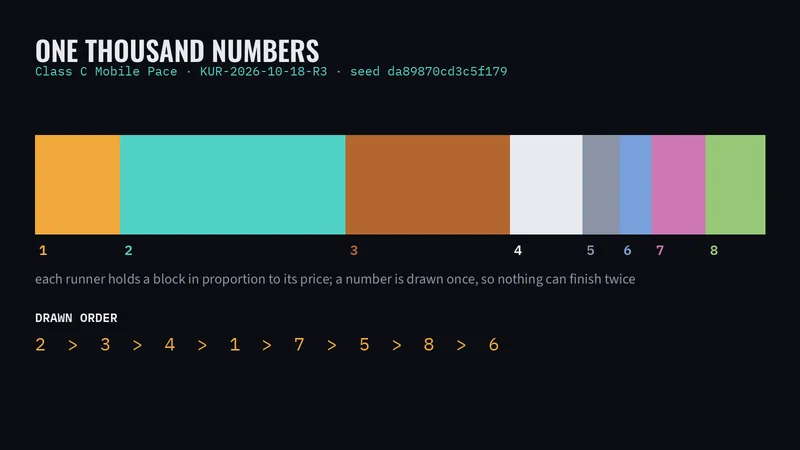
The first published window
Wren Tabakoff · 8 min
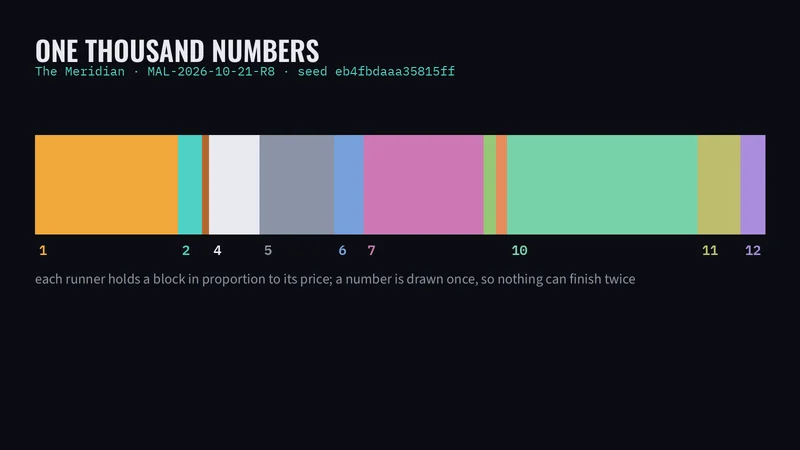
What a virtual product would have to publish
Wren Tabakoff · 7 min
The vocabulary of a simulated paceway
Mo Farrelly · 7 min
Comments (2)
Comments below the first rule arrived before this page moved to the current system and are reproduced as filed.
Ange_M
The level-price column is the one I check first now. Ran the multiplier across four other cards and it holds on all four.
leftHandTurn
Marble Bar at eight numbers out of a thousand is a strange thing to look at on a card. Eight.