Culture
The vocabulary of a simulated paceway
Mobile start, score-up, front line, death seat, mile rate. Half of these words describe something a simulated paceway does, and the other half describe something it only looks like doing.
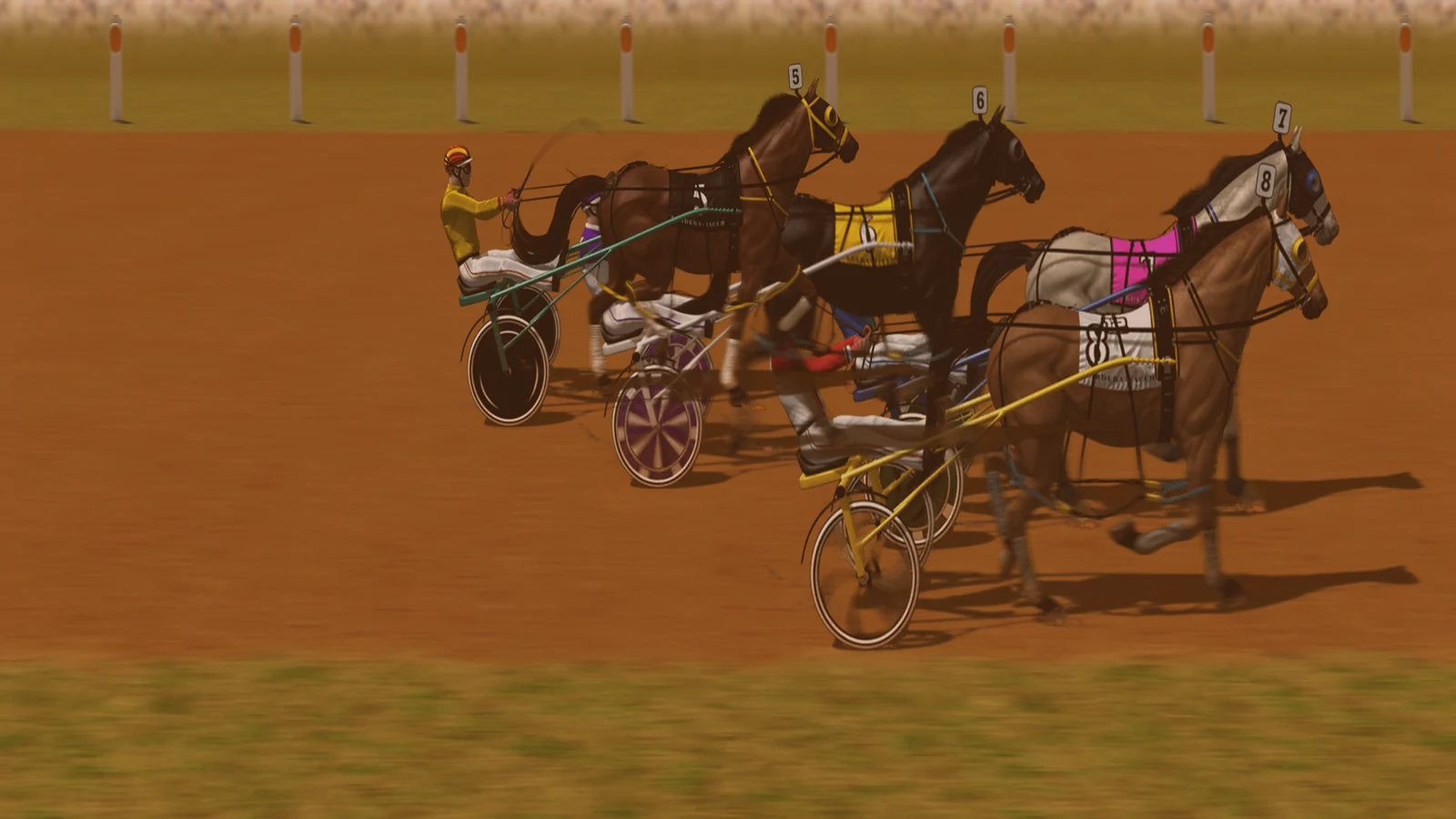
A harness card is the most word-dense page in racing. Front line and second line, score-up and standing start, the death seat and the one-one, parked out, breaking gait, the sprint lane, the pegs, and a time written as a rate rather than a duration. A simulated paceway inherits all of it, and it has no right to half of it. Working out which half is a more interesting exercise than it sounds.
The words that describe the start
These survive intact, because the start is a thing the screen does. Australia's default is the moving one: rule 142 of the Australian Harness Racing Rules says races "shall be run from mobile starts unless the Controlling Body or Chairman of Stewards otherwise approves" (read 18 October 2026). The field assembles behind a vehicle carrying two long folding arms, rolls toward the line and is released as the arms swing in. Rule 128(3) fixes the moment of participation precisely: a horse "is deemed to have participated in a mobile start when it is facing the mobile barrier and the mobile barrier starts to move".
The score-up is the run to that moment, and rule 130(5) governs behaviour during it: "Drivers shall not permit their horses to deviate from their barrier positions during the score up of a mobile start." Where the field will not fit across the track, rule 130(3) lets the Chief Steward determine how many start in any line and rule 130(4) places the outside draws "as close as practicable behind the front line" — which is where the second line comes from. Real Australian practice varies by venue: Harness Racing Australia's own track data gives Menangle a mobile field of 12 with 10 on the front line, Melton 12 with 7, and Gloucester Park 12 with 9 (read 18 October 2026). Harness Racing NSW's guidelines draw ten starters into every mobile start race, and twelve for races worth $30,000 or more at tracks of 900 metres or longer.
All of that transfers. Kurrajong Paceway runs eight across the front line over 1609 metres mobile, and the Standing Start Trot at Gidgee Paceway starts from a standstill behind tapes over 2240 metres. Both words earn their place because both starts are rendered and look like what they are called.
One rule does not transfer and its absence is instructive. Rule 141(4) withdraws a horse that causes two false starts through its own intractability and declares it a late scratching. There are no late scratchings here, no non-runners and no false starts, because a field is fixed when the card is published and the result is drawn from the published table. The rule describes a contingency the engine cannot have.
The words that describe a trip
Here is where the vocabulary starts claiming more than it can deliver. The death seat is the spot directly outside the leader, no cover and all of the breeze, and Harness Racing New Zealand's glossary calls it usually the toughest run in a race (read 18 October 2026). The one-one is one out and one back, directly behind it, with cover and still handy. Parked out means racing with at least one horse between you and the inside rail, losing ground at every turn. The sprint lane is an inward widening of the straight that gives the trailing horse a clear run, final lap only, and Harness Racing Australia records it per track as a yes or a no.
Every one of those words describes a cause. In a real race the death seat costs a horse something measurable. On this circuit it costs nothing at all, because the finishing order came out of 1,000 numbers before the first frame was rendered. Kurrajong has a sprint lane inside the pegs for the final lap and it has no effect whatever on a result. Gidgee has none, and that has no effect either.
So the house rule is simple and it is the only workable one: these words may describe the picture and never explain the outcome. "Night Shift raced in the death seat to the home turn" is a legitimate sentence about a render. "Night Shift was beaten from the death seat" is not a sentence this paper will print, because the clause after the verb is doing work the draw already did. The same goes for breaking gait: a pacer leaving its gait is a rendered event here, and no steward places anybody behind anybody for it.
The words that describe a time
This is the half of the vocabulary worth keeping without qualification, because a time is an output and not an explanation.
Mile rate is the race time normalised to one mile: gross time multiplied by 1609 and divided by the distance in metres. It exists so that trips of different lengths can be compared, and Harness Racing Australia's form-guide key writes it with a start-type suffix — MS for mobile start, SS for stand — in the form "BMR: 1:54.9MS" (read 18 October 2026). That is why a Gidgee result over 2240 metres prints two figures: Harbour Flyer went 2:39.5 for the trip, which rates 1:54.6. Over a metric mile the two collapse into one, which is why Red Gum Rebel's win in the Class C Mobile Pace reads 1:53.8 twice.
For scale, Harness Racing Australia's Grand Circuit page for 2026 gives the Miracle Mile to Leap To Fame in 1:49.0MS over 1609 metres at Menangle on 14 March, the Inter Dominion final to Captains Mistress in 1:51.8MS over 2680 metres at Albion Park on 18 July, and the A G Hunter Cup to Swayzee in 1:53.3MS over 2760 metres at Melton on 14 February (read 18 October 2026). An ordinary metropolitan mile rates 1:51 to 1:55. Both of this circuit's harness results sit in that band.
Two real conventions this circuit does not follow, stated rather than hidden. Australian harness margins are published in metres — Harness Racing Australia's form key writes a beaten margin as "btn 51.2m" and the sectional sheets list 0.0 m, 0.4 m, 3.3 m and so on. This circuit prints lengths, because lengths are what the renderer produces, and converting them would be inventing a precision the engine does not have. And the Australian class system is gone: harness racing moved to a national Rating Based Handicapping System on 1 July 2019, with conditions written as rating bands and a minimum of 30 rating points (read 18 October 2026). This circuit uses Feature, Class A, Class B, Class C, Maiden and Trial because a rating is issued by a principal racing authority and there is none here to issue one.
What the words are for, then
It would be simpler to drop the lot and print eight names and a number. The reason not to is that the vocabulary is the only part of harness racing that a simulation can inherit honestly and completely. The sulky is still a sulky, and still a gig, a bike or a cart. The person holding the reins is a driver and never a jockey — the circuit has four of them, Marnie Kessel, Dale Prentice, Ange Vuletich and Sam Oyelaran, each with two drives in the settled window. The breed is the Standardbred, defined in the Australian rules by parentage rather than by appearance, and pacers contest 80 to 90 per cent of Australian harness races, which is roughly the split on this circuit too.
There is one more reason, and it is the plainest. The only harness-specific management simulation this desk could find anywhere in the category is a demo known from a single video listing. Nobody is writing this vocabulary down for a screen. Printing it, with the half that does not apply marked as such, is a small piece of work that is simply not being done elsewhere, and the terms are all in the glossary with their sources attached.
Sources
- Harness Racing Australia — Australian Harness Racing Rules, starting rules 128, 130, 141, 142 read 18 Oct 2026
- Harness Racing Australia — how to read a form guide: mile rate with MS and SS suffixes, front row and second row, career record, beaten margins in metres read 18 Oct 2026
- Harness Racing Australia — Australasian Grand Circuit Chronicles 2026: Miracle Mile 1:49.0MS, Inter Dominion final 1:51.8MS, A G Hunter Cup 1:53.3MS read 18 Oct 2026
- Harness Racing NSW — Handicapping Guidelines effective 1 July 2023: ten starters per mobile start race, twelve for races of $30,000 or more at tracks of 900 m or longer; minimum 30 rating points read 18 Oct 2026
- Harness Racing New Zealand — glossary: death seat, one-one, parked out, trail, sprint lane read 18 Oct 2026
- Harnesslink — update on the national Rating Based Handicapping System, in place from 1 July 2019 read 18 Oct 2026
- Wikipedia — Harness racing in Australia: pacers contest 80 to 90 per cent of Australian harness races; mobile barrier mechanism read 18 Oct 2026
More from the desk

What a simulator models
Ilsa Brandt · 7 min
The first published window
Wren Tabakoff · 8 min
The cost of the book
Mo Farrelly · 6 min
Comments (2)
Comments below the first rule arrived before this page moved to the current system and are reproduced as filed.
Bess_T
The rule about describing the picture but never explaining the result is the best editorial line on this site.
peggy_o
Printing lengths and saying why, instead of faking metres to two decimals, is the right call.