Explainer
What a simulator models
A speed curve, a gene, a distribution, a population sink and a career ladder. A draw engine holds one number, and this is what the other five are for.
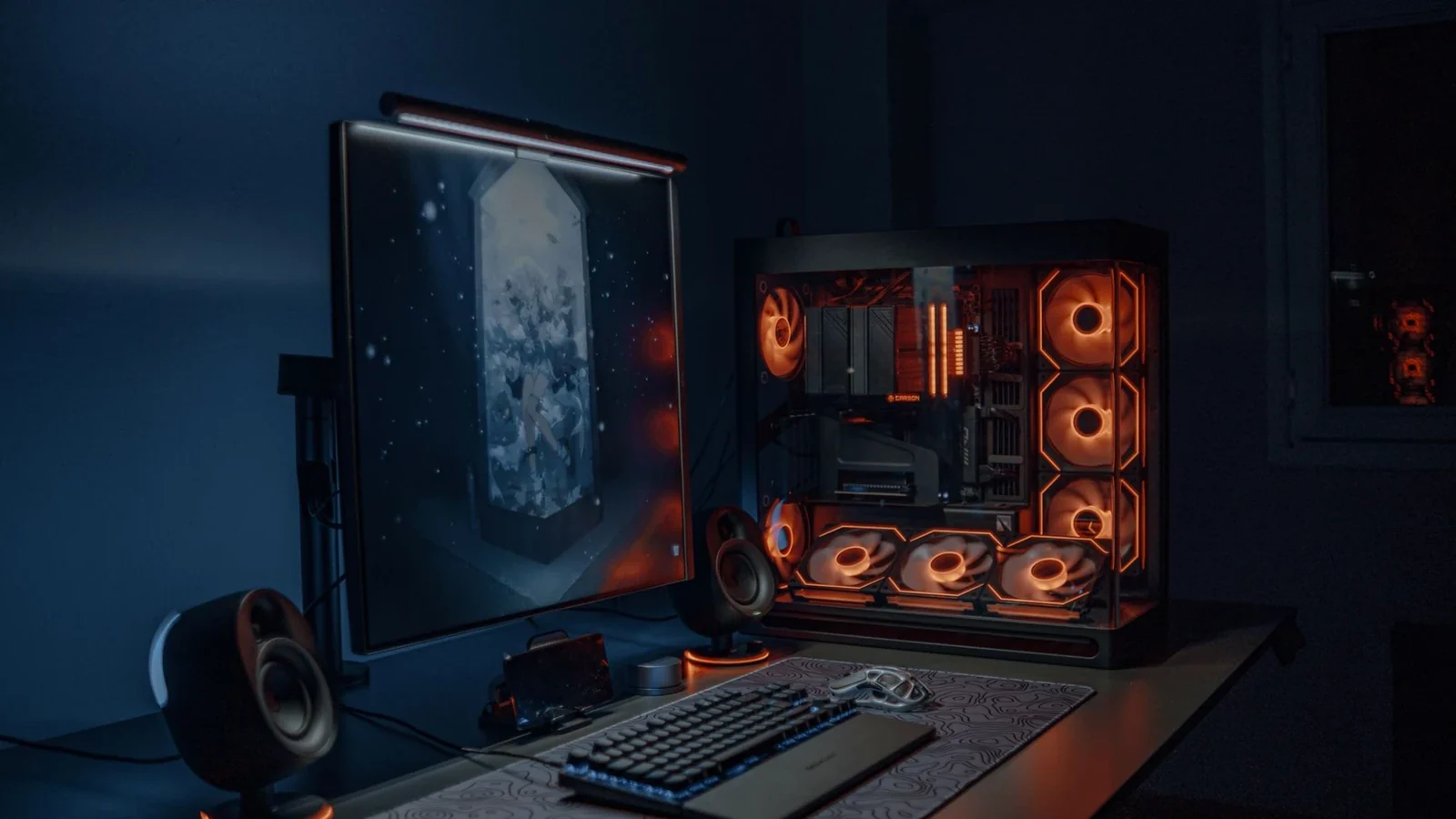
Two different things are called virtual horse racing and the difference is not how good the graphics are. A shop-screen race is decided by a draw and then rendered. A simulation game builds a model of a horse and reads the result off it. If you want to understand either one, the quickest route is to list what the model contains, and then notice that a draw engine contains none of it.
Here are five modelled quantities, each taken from a published description, and then the one number this circuit holds.
1. A speed curve with a decay term
The only fully documented engine in the category is also the oldest. Ian Cummings, who spent ten years at EA Sports as creative director of the Madden NFL franchise, built the original mobile Photo Finish Horse Racing in Unity over a few months in 2015 and wrote the engine up on Game Developer on 5 May 2016 (read 18 October 2026). Four attributes on a 100-to-1,000 scale are mapped onto physics constants. Acceleration changes the base acceleration value. Top Speed changes the maximum. Finish is applied through the whip input. And Stamina sets the rate at which speed decays once top speed has been reached.
Each horse runs an update loop: speed rises by an acceleration constant until it reaches top speed, is clamped there, then decays each step but never below a minimum. Fatigue in that engine is literally a decay term with a floor. The constants were tuned by eye so that the best possible horse covers a quarter mile in about 20 seconds, against a real-world record the post cites at 20.57, and the slowest in about 35. Movement is driven by the transform alone, with the animated model a child object disabled in testing, so the animation can never affect the speed or the distance.
Nothing on this circuit corresponds to any of it. There is no speed, no decay, no floor. Note the caveat too: that write-up describes the 2015 mobile game, not the current product.
2. Inheritance
The most explicitly documented genetics system on Steam belongs to the smallest studio on it. Sheep Meadow Road Games' Horse Racing Manager, in Early Access since 24 October 2025, advertises a Pseudo-DNA system passing speed, stamina, acceleration, temperament and soundness from both parents through dominant and recessive genes — its own store page puts it as breeding "where genetics actually matter", and the developers state the game will leave Early Access on 4 December 2026, caveated as dependent on progress (read 18 October 2026, when the page showed Very Positive at 88 per cent of 224 reviews).
Note what a genetics system buys: a horse's chance becomes a consequence of decisions taken seasons earlier. That is the honest sense in which these games are games. It also means the game grades races on the real pattern ladder, Not Graded through Listed and Group 3, 2 and 1 — which this circuit deliberately does not use, because Group status is conferred by a principal racing authority and a simulated circuit has none.
3. A distribution you can shape
ZED RUN, built by the Australian studio Virtually Human, resolved a race by running 10,000 random outcomes and selecting one as the race conditions, over horses whose smart-contract traits were not fully revealed until the horse had raced (Yahoo Finance Australia, 13 January 2022, read 18 October 2026). The subtlety is worth holding on to: the randomness picks among pre-computed outcomes rather than rolling a winner directly. Reported mechanics add bloodline weighting, distance and gate preferences, a fatigue factor, and stamina below 90 per cent degrading performance with about twelve hours to full recovery; a new horse ran one race and then nine more to set its class rating. Win probabilities were hidden from everyone, so race history was the best available information.
So the player's decisions move the distribution and never the individual result. The Polygon version shut down on 28 February 2025, reported by Decrypt on 28 April 2025; a successor relaunched on Base with 4,320 horses, and this desk cannot confirm its liveness in 2026, so does not assert it.
4. A population sink
This is the mechanic nobody writes about and every long-lived stable game has. SIMHorseRacing, running since 1998 according to community sources, compresses a full racing year into 16 real weeks, races five days a week, and allows a mare to be bred only once a year. Each year a random process makes some mares barren and some stallions infertile, explicitly to control population growth (read 18 October 2026, from a player-written rulebook, so treat it as historical rather than current). Newturf gave its horses an eight-month career. Photo Finish LIVE retires a horse at eight, with a season of roughly four real weeks to a game year.
ZED RUN's critics argue that its collapse followed from the absence of exactly this: uncapped breeding supply, newborns drifting further from the genesis base, and no sink. This desk reports that as their argument rather than as a finding, because no audited analysis of it exists. But the design point stands on its own: a simulated population needs a way to lose horses, and a draw-based circuit needs none, because its runners are rows in a file.
5. The furniture of a career
Strategic Designs, founded in Manchester in 2004 by Mark Loveday, goes further than anyone at simulating the surroundings rather than the horse. Starters Orders 7 advertises stewards' enquiries, non-triers, fines, photo finishes and handicapping, with breeding lineage and lifetime statistics readable back over a century (read 18 October 2026; the release date is a three-way argument, with the developer's own page saying December 2018 and Steam saying 2 May 2019). The announced sequel is listed on Steam with a release date to be announced, and promises separate UK, North American, French, Irish, Australian and Japanese game modes, jockey fitness and injuries, and stride data on yearlings hinting at future potential.
Three of the biggest titles in the category are made in this part of the world, which is worth noting on an Australian desk. PikPok, of Wellington, released Rival Stars Horse Racing free on mobile worldwide on 24 April 2019 and on consoles on 28 April 2026, with the Nintendo Switch version on 28 May 2026 at 29.99 in its own launch post; Tru Blu Games put it on disc and cartridge for the first time from 30 July 2026. The same studio lineage made Phar Lap: Horse Racing Challenge, published by Tru Blu for Australian release on 22 March 2019, which the Australian Xbox store rates Mature 15+ with a simulated-gambling descriptor because of a mode in which friends bet with one another. And the ancestor of both, Melbourne Cup Challenge, came out of Sidhe Interactive in 2006 with 20 racecourses including licensed Flemington, Caulfield and Ascot and motion capture help from Weta Digital (all read 18 October 2026).
What a draw holds instead
| Quantity | Simulation game | GP-Draw 4.2 |
|---|---|---|
| Speed | A constant, modified per horse | Absent |
| Stamina | A decay rate with a floor | Absent |
| Inheritance | Dominant and recessive genes | Absent |
| Preference | Surface, direction, condition | Absent |
| Fatigue across a career | Rest, recovery, retirement age | Absent |
| Chance of winning | Emergent and hidden | Numbers held, printed on the card |
Take one runner. In the Kurrajong Mile at Kurrajong Paceway, Night Shift holds 271 of the 1,000 numbers and Salt Pan holds 44. Night Shift has no stamina figure, no gene and no surface preference. It holds 271 numbers, so it wins 27.1 per cent of the time and 6.2 times as often as Salt Pan. That is the entire model, and the card prints it.
One real axis does survive the translation, and it is cosmetic. Photo Finish LIVE gives each horse a direction preference, left-handed or right-handed, which is exactly the split between Mallee Park and Jacaranda Downs. In that game the preference changes a probability. Here the shape of the circuit changes what the screen shows and nothing in the weighting table.
None of this ranks the two. A game with genetics in it has something for form to be about, and a draw has a table — which is published here and almost nowhere else. One closing observation for anyone looking for the gap in the category: the only harness-specific management simulation this desk could find anywhere is a demo known from a single video listing. The standardbred half of the sport is close to empty, which is one reason the free play-credit game at play/ is a harness race.
Prices on this page are the draw weighting in another notation. They are reference figures published with the card, not odds available anywhere, and not a betting recommendation.
Sources
- Game Developer — Ian Cummings, "The making of mobile game Photo Finish Horse Racing", 5 May 2016: attributes mapped onto physics constants, Stamina as speed decay rate, quarter mile tuned to about 20 seconds read 18 Oct 2026
- Steam — Horse Racing Manager (Sheep Meadow Road Games): Pseudo-DNA, dominant and recessive genes, Early Access 24 October 2025, Not Graded to Group 1 ladder read 18 Oct 2026
- Yahoo Finance Australia, 13 January 2022 — ZED RUN and Virtually Human Studio: 10,000 random outcomes per race, one selected read 18 Oct 2026
- Decrypt, 28 April 2025 — ZED RUN shut down 28 February 2025; successor on Base with 4,320 horses read 18 Oct 2026
- Naavik — ZED RUN mechanics: bloodline weighting, stamina below 90 per cent, class-setting races, hidden win probabilities read 18 Oct 2026
- Steam — Starters Orders 7 (Strategic Designs Ltd): stewards' enquiries, non-triers, fines, handicapping, lineage over 100 years read 18 Oct 2026
- Strategic Designs Ltd — studio and catalogue, founded Manchester 2004 by Mark Loveday read 18 Oct 2026
- PikPok — Rival Stars Horse Racing mobile launch, worldwide 24 April 2019 read 18 Oct 2026
- Rival Stars Horse Racing — console launch post, 28 April 2026, Switch 28 May 2026, priced 29.99 read 18 Oct 2026
- Tru Blu — Phar Lap: Horse Racing Challenge, Australian release 22 March 2019, published with PikPok read 18 Oct 2026
- Wikipedia — Melbourne Cup Challenge (Sidhe Interactive, 2006): 20 racecourses including licensed Flemington, Caulfield and Ascot; Weta Digital motion capture read 18 Oct 2026
- GLI-33 Event Wagering Systems v1.1, 14 May 2019, section 4.5 — a physics engine may use the random properties of an RNG to impact a virtual event outcome, evaluated case by case read 18 Oct 2026
More from the desk
What the 2020 models were fed
Ilsa Brandt · 7 min
The vocabulary of a simulated paceway
Mo Farrelly · 7 min
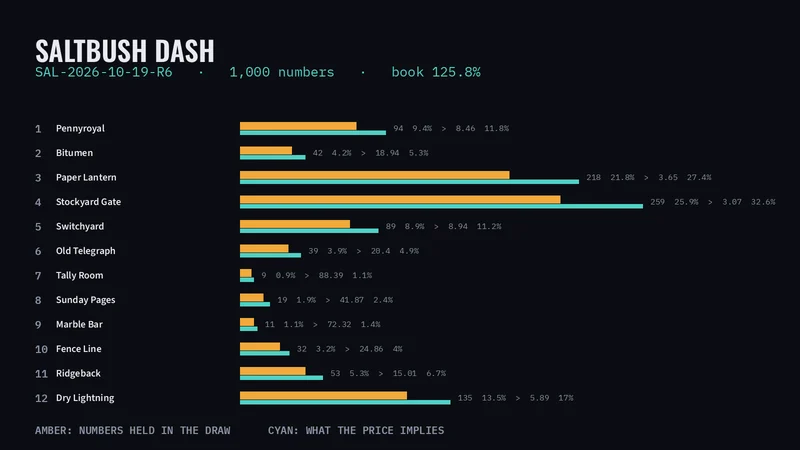
The cost of the book
Mo Farrelly · 6 min
Comments (2)
Comments below the first rule arrived before this page moved to the current system and are reproduced as filed.
stable_hand_7
The population sink section explains something I had noticed in three different games and never had a word for.
Tam_R
Fatigue as a decay term with a floor. That is a very honest sentence about a horse.